
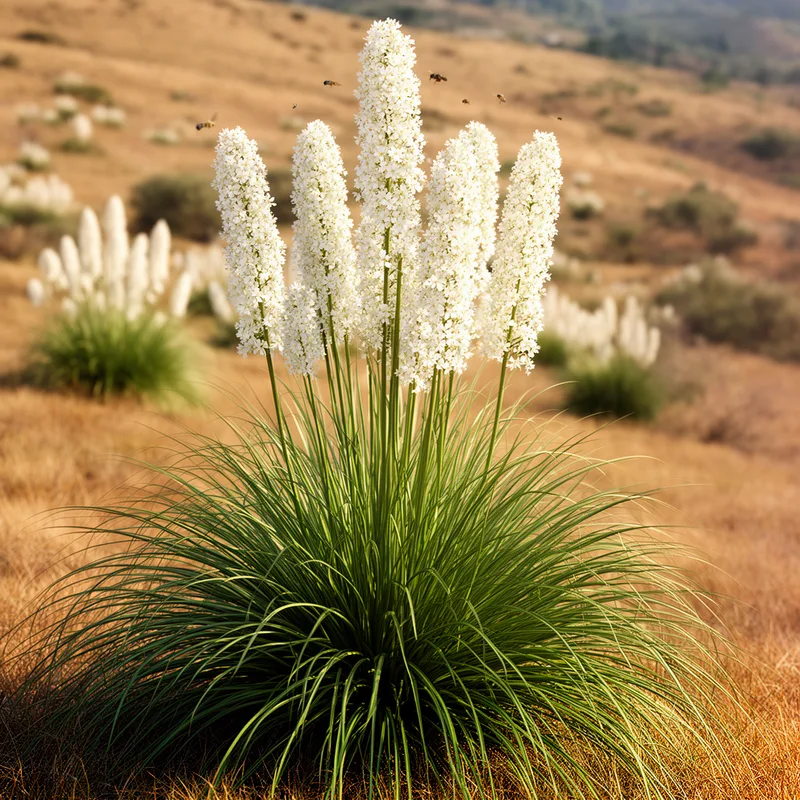
bear grass
- noun
- /bɛr ɡræs/
- US
- In the spring, the forest floor is covered with blooming bear grass that attracts many hikers.
Examples
-
The gardener used bear grass to add texture to the landscape, complementing the colorful flowers.
-
Northeastern Yavapai oral history reported houses made of pole frameworks with three layers of thatching: first star bush, next Johnson grass, and finally bear grass or juniper bark.
Academic text (1999) -
Hey, I got your bear grass.
-
She sat at a kitchen table with the fragrant, newly dried bear grass and yucca laid out on the table.
Fiction book (2000) -
After the rain, the tall stalks of bear grass stood out prominently against the clear blue sky.
Synonyms
A plant from west-central US with long narrow leaves at the base and a tall stalk of small white flowers

A plant with a group of long narrow leaves and a tall stalk of small white flowers
A long-living plant from western North America with stiff grasslike leaves and spikes of creamy white flowers
A small stemless plant with groups of grasslike leaves and upright clusters of creamy white flowers
How Tall


Surface Forms
Morphology
The phrase names a specific perennial plant species and its meaning is not a predictable compositional combination of the listed constituents. The listed 'bear' (to give birth) plus 'grass' does not yield the idea of a particular yucca-like plant (and even if read as 'bear' the animal, it would only suggest association with bears), so a B1 learner who knows the component words would not reliably infer the botanical meaning.
Etymology
Bear grass may come from people who saw bears digging up and eating its thick roots, so they started calling that grass the bear's food. That's why bear grass today means a tall, 'grasslike' 'plant'.