
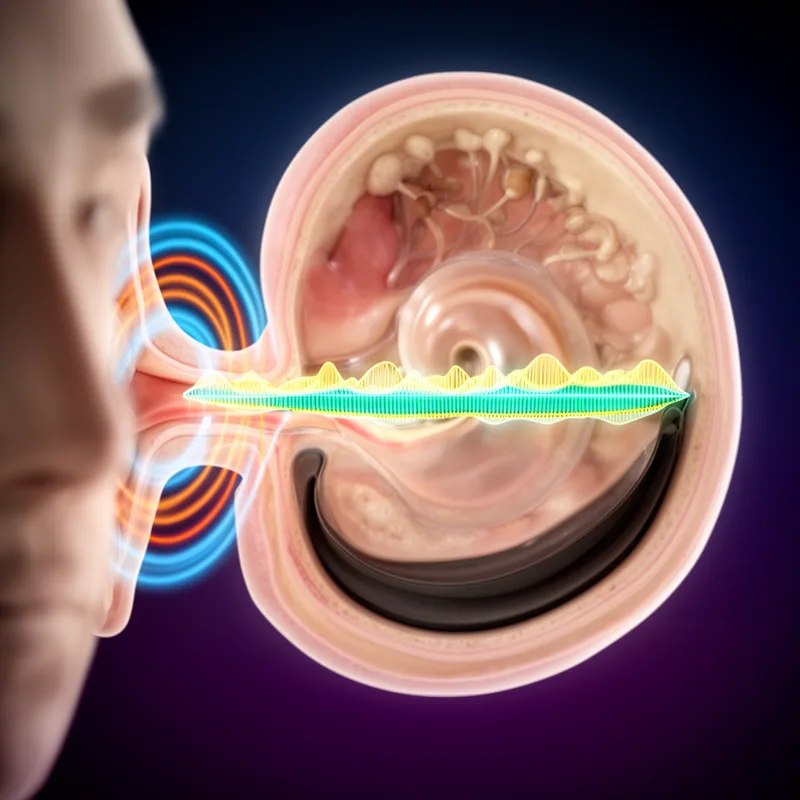
basilar membrane
- noun
- /ˈbæzɪlər ˈmɛmˌbreɪn/
- Specialized
- When sound enters the cochlea, it causes the basilar membrane to move, triggering the hair cells to send signals to the brain.
- basilar membrane motion
- basilar membrane vibration
- basilar membrane and the tectorial
Examples
-
While the resulting effect of these two peaks is a wider area of damage along the basilar membrane, there is a reduced overall degree of missing outer hair cells.
Academic text (1998) -
Both outer and inner hair cells are thought to be stimulated by movement of the basilar membrane in response to sound.
Academic text (1998) -
These cells are sitting on the basilar membrane and the hair bundle is moving back and forth.
-
This is the length along the basilar membrane from the base over here on the right to the apex.
-
The unconditioned group showed a discrete loss of the outer hair cells in a particular area on the basilar membrane, usually around the 14 to 15 mm distance from the round window.
Academic text (1998) -
Above 80 dB SPL, the relationship between basilar membrane vibration and sound intensity again becomes linear.
Academic text (1998) -
If the oscillatory motion of the outer hair cell is in phase with the acoustic vibration, there will be positive feedback to basilar membrane motion and amplification.
Academic text (1998) -
Differences between the responses of the basilar membrane (BM), tectorial membrane (TM), and outer hair cell (OHC).
Academic text (1998) -
For the purpose of illustration, assume that the basilar membrane, tectorial membrane, and OHCs are each elastic in the tuned region of the cochlear partition.
Academic text (1998) -
As a result, the electromechanical force attenuates the motion of the basilar membrane. Clearly, this mechanism cannot produce cochlear tuning; the OHC acts as a brake.
Academic text (1998)
Surface Forms
Morphology
Both constituents are compositional: 'basilar' means 'pertaining to the base' and 'membrane' is a thin layer, so a B1 learner who knows those words can infer this refers to a membrane located at the base of a structure. The technical anatomical details (cochlea, organ of Corti, specific role in hearing) are domain-specific but do not prevent the core spatial/functional meaning being transparently derived.
Etymology
Basilar membrane comes from basilar meaning 'base' and membrane meaning a thin layer, because it is a thin layer at the base of the inner ear. So it means the thin base layer that vibrates to carry sound and help hearing.

