
barotrauma


 1
9.6
- noun
- /ˌbɛəroʊˈtrɔːmə/
- Specialized
- Fish commonly suffer barotrauma caused by rapid decompression as they are hauled to the surface by conventional fishing techniques.
Examples
-
Depth changes without adequate time for the divers to equalize pressure in internal air spaces could result in barotrauma, air embolism, or other related problems.
Academic text (1991) -
If snorkeling, ear and sinus barotrauma are of concern, as rapid ascents and descents can occur during underwater tows.
Academic text (1994) -
Fish were brought up from depths as great as 64 m with no signs of barotrauma (e.g., gas bubbles in the eyes).
Academic text (1998) -
Formal ventilation of patients with choriocarcinoma has resulted in 100% mortality from barotrauma-induced damage.
Academic text (1992) -
However, these fish routinely suffer severe barotrauma when hauled to the surface from their normal depths of 65-100 m (Parrish, 1989).
Academic text (1992) -
All sled users should have a working knowledge of Boyle's Law and understand the possible problems involved with pressure-volume changes (e.g., barotrauma, air embolism, and other related problems).
Academic text (1991) -
The interception of hauled fish at an intermediate depth by divers offers the potential to prevent damaging barotrauma by minimizing the expansion of the swim bladder.
Academic text (1992) -
BIPAP settings may have led to large or varying tidal volumes in patients, which could have led to increased barotrauma (4), atelectrauma (4), and biotrauma (4) in the injured lung (5).
Academic text (2015) -
Underwater towing procedures, including advanced diving techniques, hold a higher potential for barotrauma injuries and thus should only be practiced by divers competent in gear manipulation, buoyancy control, and in proper physical condition.
Academic text (1994) -
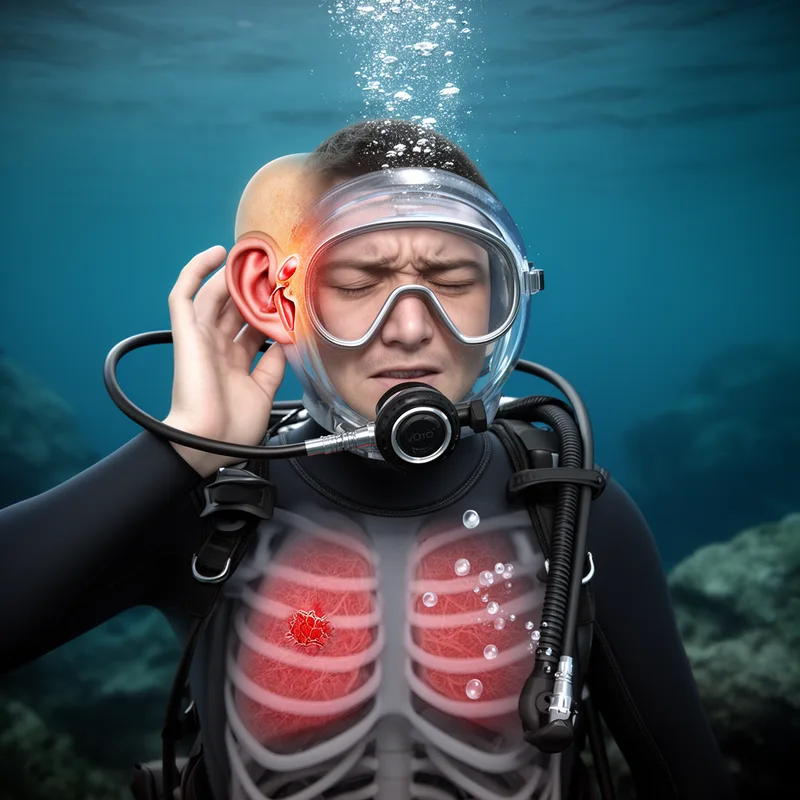
Rapid ascents during scuba diving can cause barotrauma, leading to serious injuries in the ears and lungs.
Surface Forms
Morphology
Etymology
The word barotrauma comes from two Greek parts: baro- meaning 'pressure', as in barometer, and -trauma meaning 'injury' or 'wound'. So, barotrauma is an injury that happens when changes in pressure harm body tissues, like in the ears or lungs.