

banzai attack
- noun
- /bænˈzaɪ əˈtæk/
 :
ataque banzai
:
ataque banzai
- A sudden banzai attack could wipe out thousands of our men before they ever knew what hit 'em.
Examples
-
At the Barrio of Misinsiman, just as the leading battalion was going into perimeter for the night, another fanatical Banzai attack occurred, in which fifty-eight of the enemy were killed in an hour's fighting.
Fiction book (1990) -
During World War II, the troops faced a fierce banzai attack that overwhelmed their defenses and caused significant casualties.
-
We Americans cannot understand the fanaticism behind a 'Banzai' attack unless we know the background and way of life of the Japanese people, who have behind them centuries of training in non-thinking submissiveness.
Fiction book (1990) -
The night after the battle finally ended, a Japanese banzai attack against the 2nd Battalion was met with effective retaliation, resulting in hundreds of enemy dead and earning the battalion special recognition from General Eichelberger.
Fiction book (1990) -
The soldiers braced themselves for the imminent banzai attack from the enemy forces, knowing the ferocity of the charges they had encountered before.
-
With courage and determination, the troops prepared for a banzai attack, aware that the reckless nature of such assaults often led to high casualties.
Synonyms
 ∞
1.4
∞
1.4

A violent action that harms people or damages things
 423
6.9
423
6.9
Close fighting during the final part of a military attack


 1
7.3
1
7.3
A very strong action to defeat an enemy or opponent using the most force
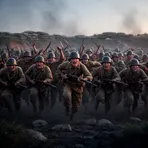
A mass attack, especially by Japanese soldiers in World War II, where they rush the enemy while shouting 'banzai'
How Reckless

Surface Forms
Morphology
Although the parts 'banzai' (a cheer) and 'attack' (an act of violence) give a loose clue — an attack associated with shouting or a spirited charge — the full sense (a mass, often reckless or suicidal military charge historically linked to Japanese soldiers) depends on cultural and historical knowledge. A B1 learner who only knows the literal constituents is unlikely to infer the specialized, historically loaded meaning without prior exposure.
Etymology
Banzai attack comes from old battles where soldiers shouted banzai and rushed forward together in a mass attack, often risking their lives. That's why the term now means 'a reckless or desperate charge'.