
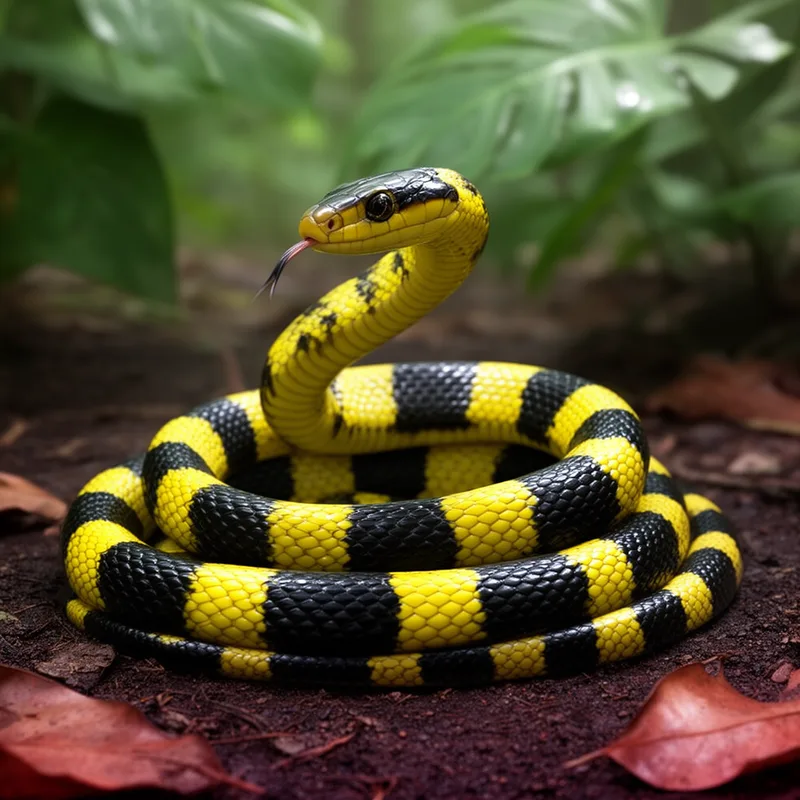
banded krait
- noun
- Indian
- The banded krait is known for its distinctive black and yellow stripes and is found throughout South and Southeast Asia.
Examples
-
The banded krait can be identified by its striking black and yellow bands as it slithers through the grass.
-
Spotting a banded krait in the wild is rare, as it is primarily nocturnal and shy.
-
Despite its potent venom, the banded krait is usually not aggressive toward humans.
-
The banded krait is known for its potent venom.
-
Have you ever seen a banded krait in the wild?
-
When threatened, the banded krait may become motionless, relying on its camouflage to avoid detection.
-
In some regions, the banded krait is regarded as a dangerous snake due to its highly toxic venom.
Synonyms

 1
9.9
1
9.9

A venomous snake from Southeast Asia that is often brightly marked and usually not aggressive

A large venomous snake with black and yellow bands from South and Southeast Asia
A venomous snake with black and yellow bands that moves slowly and avoids people

A group of very venomous snakes called kraits that live in South and Southeast Asia
Surface Forms
Morphology
The noun phrase is a straightforward adjective + noun composition: 'banded' means marked with bands and 'krait' is a venomous snake, so the phrase simply denotes a krait that has bands. This descriptive, compositional pattern is common across languages and would be immediately understandable to a B1 learner who knows both constituents.
Etymology
Banded krait likely gets its name from how it looks and from local names for deadly snakes. The word banded points to the clear black and yellow rings on its body and krait comes from a South Asian name for a 'venomous' snake, so the name simply describes a dangerous striped snake.