
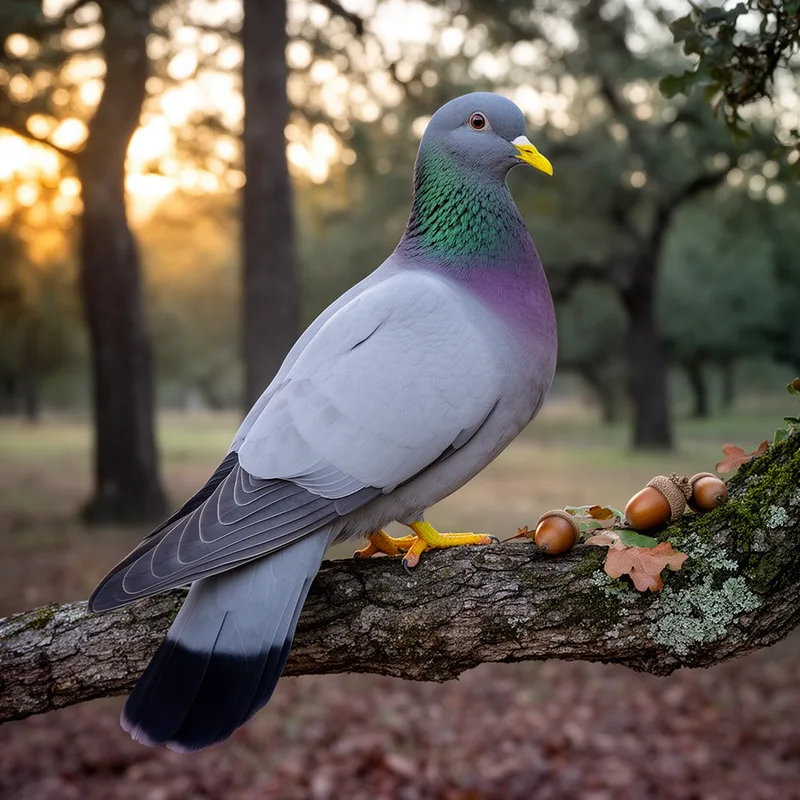
band-tailed pigeon
- noun
- /bænd-teɪld ˈpɪdʒən/
- US
- The band-tailed pigeon is often seen feeding on acorns in oak woodlands.
Examples
-
Unlike the extinct passenger pigeon, the band-tailed pigeon still inhabits much of western North America.
-
A flock of band-tailed pigeons visited the forest clearing at dawn.
-
The band-tailed pigeon is a beautiful bird.
-
Look at that band-tailed pigeon sitting on the branch!
-
The band-tailed pigeon is easily recognized by the broad dark band on its tail.
-
In western North America, the band-tailed pigeon can often be spotted in forested areas.
-
Many birdwatchers hope to see a band-tailed pigeon during their hikes in the mountains.
Synonyms

A large wild pigeon that lives in western North America and has a band on its tail

A wild pigeon from western North America that is larger than city pigeons

A wild pigeon from western North America often mistaken for the passenger pigeon
Surface Forms
Morphology
band-tailed + pigeon
The compound is fully compositional: 'band-tailed' means having a band on the tail and 'pigeon' names the bird, so a learner who knows 'band', 'tail', and 'pigeon' can infer it denotes a pigeon with a banded tail. This adjectival‑noun formation is a regular, cross‑linguistic descriptive pattern in English and therefore readily understandable at B1.
Etymology
Band-tailed pigeon gets its name from the wide dark band on its tail. That clear stripe is the easiest way to spot and remember this wild pigeon, and it is why the bird is called a 'band-tailed' pigeon today.

