
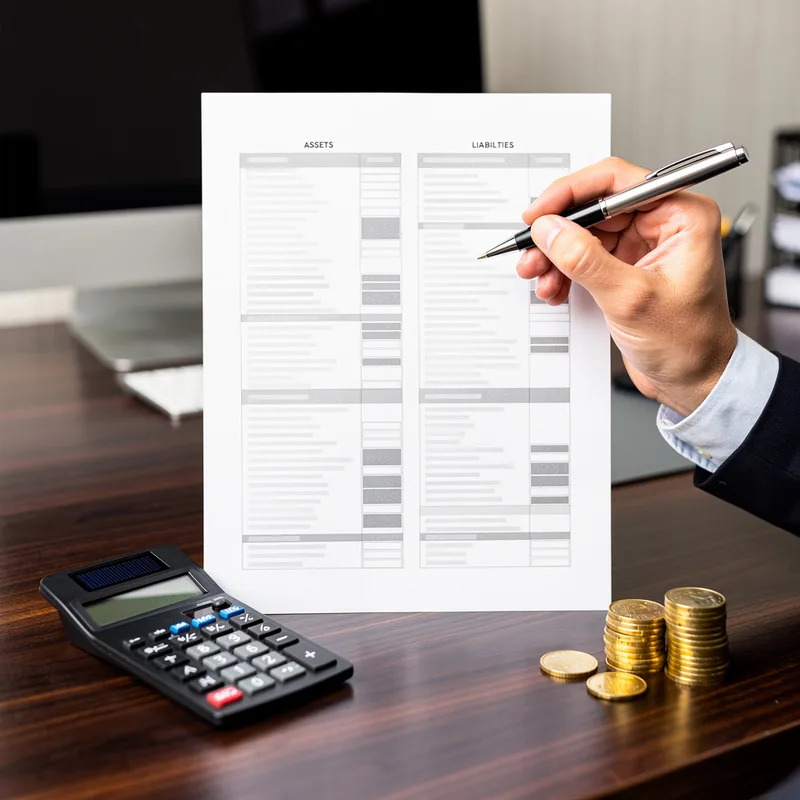
balance sheet
 44
3.7
44
3.7

- noun
- /ˈbæl.əns ʃiːt/
- Specialized
- Banks have to hold the debt of these firms on their balance sheets for extended periods of time.
- income statements and balance sheets
- income statement and balance sheet
- balance sheet (BS)
Loading YouTube…
Watch on YouTubeNow don't get me wrong, the company's balance sheet is strong, very strong.
- Now don't get me wrong, the company's balance sheet is strong, very strong.
- Banks have to hold the debt of these firms on their balance sheets for extended periods of time.
- The government has taken the exchange rate risk onto its balance sheet with the savings product.
- The answer was to monetize the government side of the balance sheet and what they're actually doing.
- For all its scandals and mistakes, Credit Suisse did have a strong and liquid balance sheet as of Wednesday.
- Because they want to use, they want their cash reserves on their balance sheet.
- So when it comes out, a coin Desk report came out that FTX's balance sheet wasn't looking that good, like it looked pretty weak.
- So any public company's balance sheet is on on the web and it's they're updated every three months.
- We will match the Chinese multi billion dollar computing infrastructure, take it off your balance sheets to maintain global leadership in this field.
- Since then, they've prioritized strong balance sheet and have become more cautious about investing in new projects.
- FDX's balance sheet was allegedly just a House of Cards and now it's all come crashing down.
- And you might, your balance sheet might look great, but your cash statement might not.
Examples
-
Financial data on the firm must include balance sheets, income statements, and statements of cash flow.
Academic text (1991) -
Far more relevant is the balance sheet, which shows assets and liabilities.
Academic text (2005) -
But when you do the balance sheet, what do you think?
-
We'll work out the balance sheet later.
-
Look at the balance sheet.
-
The debt shows as an asset on our balance sheet.
-
And they have a good balance sheet because that means stability.
-
Now, all of these parts of the balance sheet should be about utility.
-
Now don't get me wrong, the company's balance sheet is strong, very strong.
-
The accountant prepared the balance sheet to summarize the company's financial position at the end of the fiscal year.
Surface Forms
Morphology
The compound is directly compositional: 'balance' (a financial amount or position) combined with 'sheet' (a piece of paper/document) yields a document listing balances or financial positions. This makes the general sense of a financial statement understandable to a B1 learner who knows both constituents, even if they lack technical accounting detail.
Etymology
Balance sheet comes from old bookkeeping. It was a sheet of paper that showed two lists, what a company owned and what it owed, and the totals had to balance. So today balance sheet means 'a statement that shows what a company owns and owes at a particular date'.