
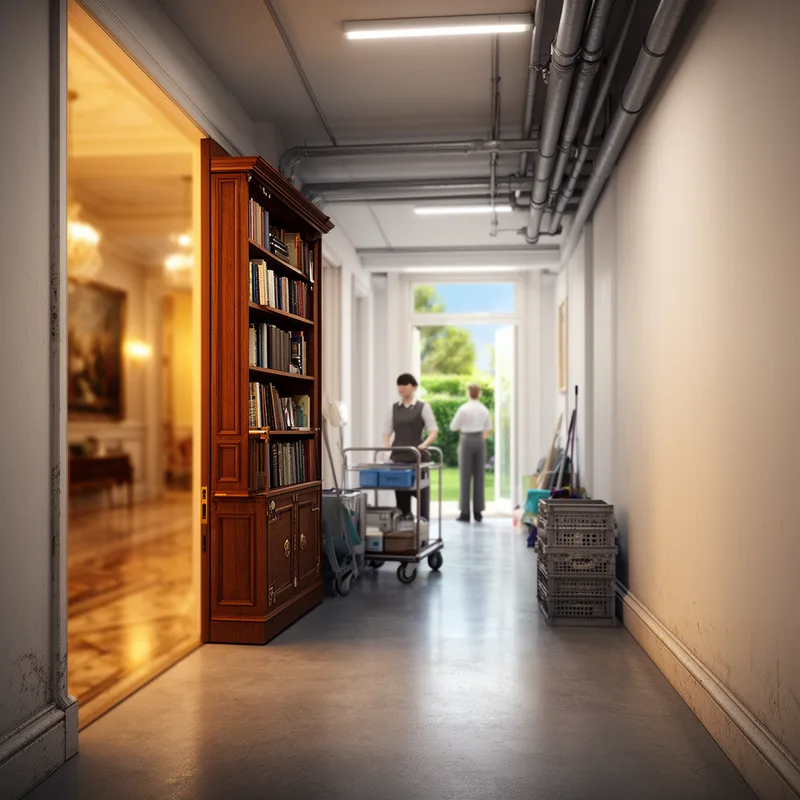
back passage
- noun
- UK
- Servants would often move through the back passage to avoid disturbing the guests.
Examples
-
The back passage leads to the garden.
-
We decided to use the back passage to reach the garden without being noticed.
-
During renovations, they discovered a hidden back passage behind the old bookshelf.
-
She took the back passage to avoid the crowd.
-
The staff decided to use the back passage to avoid the crowded front entrance of the building.
-
During the tour, the guide pointed out the back passage that led to the garden away from the main hall.
-
The back passage was dark and narrow, often used by employees to reach the parking lot without being seen.
Synonyms
 459
1.0
459
1.0

A long narrow passage inside a building with doors to rooms
 295
2.5
295
2.5
A long narrow passage inside a building with doors to rooms on both sides
 50
3.2
50
3.2
A long narrow space that connects rooms or parts of a building
How Private

Surface Forms
Morphology
The meaning 'a rear or less-used corridor' is directly and transparently derived from combining 'back' (situated at the rear) with 'passage' (a passageway). This simple adjective + noun composition follows common cross-linguistic patterns, so a B1 learner who knows both constituents would readily infer the intended meaning.
Etymology
Back passage comes from old houses where house staff used a narrow hallway behind the main rooms to move quietly and not be seen. The words back and passage give the picture of a rear, private route, so the term now means 'a less used or private route at the rear of a building'.