
azimuthal
- adjective
- /ˌæzɪˈmjuːθəl/
- Specialized
- This function is invariant under azimuthal rotations.
- azimuthal asymmetry
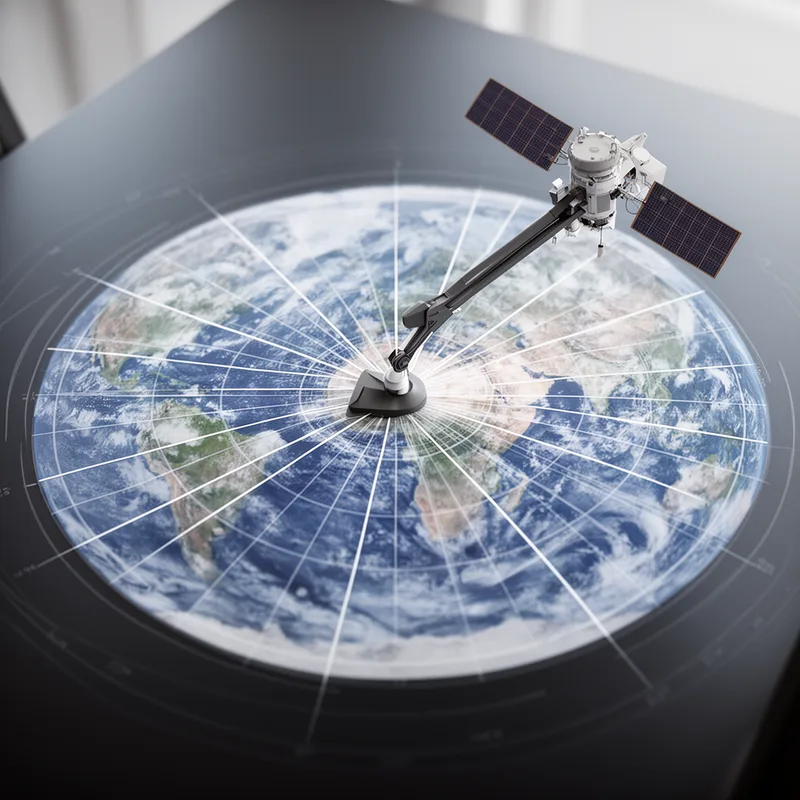
- azimuthal projection
- azimuthal angle
Examples
-
The polarization of Brookhaven National Laboratory's LEGS ladon beam has been determined with high accuracy by measuring the azimuthal asymmetry of neutral-pion photoproduction on helium.
Academic text (2005) -
Therefore, the observed azimuthal asymmetry becomes a direct measure of the gamma-ray beam's polarization.
Academic text (2005) -
Polar and azimuthal angles refer to the beam axis.
Academic text (2012) -
The azimuthal component of the magnetic field was assumed to be small in comparison to the longitudinal component.
Blog text (6) -
The observed azimuthal asymmetry (solid data points) is a measure of the gamma beam's polarization.
Academic text (2005) -
The Chicago Mercantile Exchange, to show its new link with the Singapore International Monetary Exchange for futures and options trading, used an azimuthal projection centered on the North Pole.
Academic text (1991) -
Because nonlinear internal waves are more directional than the random, isotropic linear internal waves, they can produce a strong azimuthal dependence in the scattering.
Academic text (2004) -
The first experiments at the Brookhaven and Frascati hadron-beam facilities revisited the classical problem of deuteron photodisintegration by measuring the azimuthal asymmetry.
Academic text (2005) -
Different origins for the instabilities (such as transverse, longitudinal, and azimuthal instabilities) have been investigated recently, and the results have shed new light on nonlinear dynamics.
Academic text (1998) -
In meteorology, the azimuthal angle is crucial for understanding wind patterns.
Synonyms

 7
5.7
7
5.7

Relating to angles or how fast something turns
Surface Forms
Morphology
Etymology
Azimuthal comes from azimuth, which in turn came from the Arabic word samt meaning 'direction'. So azimuthal is used for measurements of 'direction' — the angle or bearing around a point, which is why astronomers and mapmakers use it to point telescopes or show compass directions.