
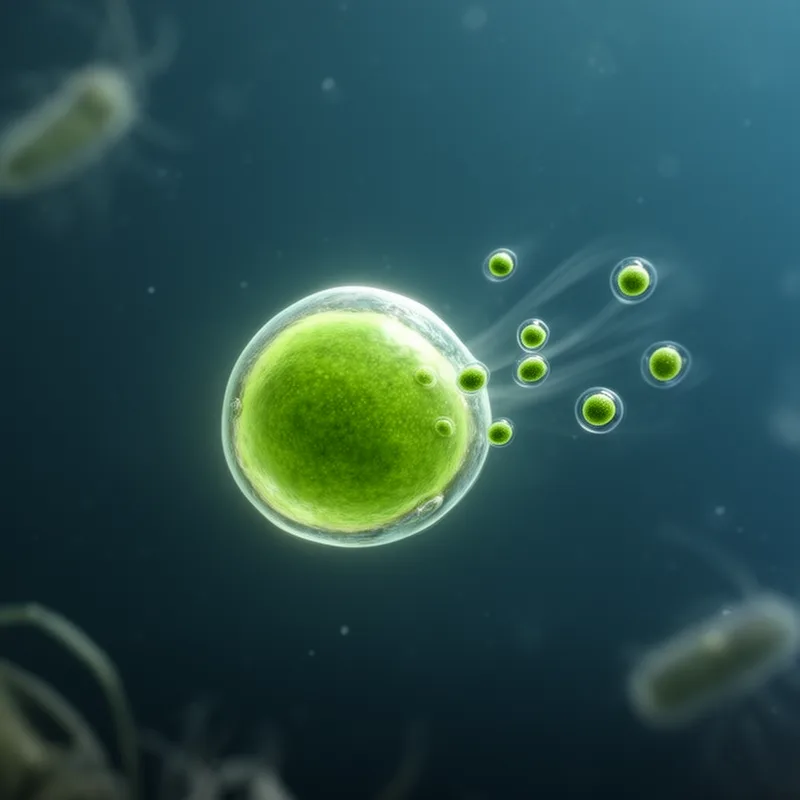
autosporic


 1
9.9
- adjective
- /ˌɔːtəˈspɔːrɪk/
- Specialized
- Researchers observed that the autosporic species produced single spores rather than groups.
Examples
-
The autosporic nature of this microorganism allows it to reproduce without forming spore clusters.
-
Some green algae are autosporic, releasing individual spores into their environment.
-
The autosporic algae reproduce by forming single spores.
-
Many autosporic species thrive in isolated environments.
-
In laboratories, scientists often study autosporic organisms to understand how they reproduce without forming clusters.
-
The autosporic nature of these algae allows for individual spore production, facilitating independent growth in diverse environments.
-
Researchers noted that the autosporic species could thrive in conditions where clustered spores would fail to adapt.
Surface Forms
Morphology
autosporic = autospore (semi-transparent) = auto + spore + ic
The adjective is formed from the technical noun 'autospore' plus '-ic', but the biological sense is specialized rather than fully predictable for an average learner.
Etymology
Autosporic comes from auto- 'self' and spore 'tiny seed'. The auto- is the same 'self' in 'automatic', so autosporic describes an organism that makes single 'seeds' called 'spores' by itself rather than in groups.