
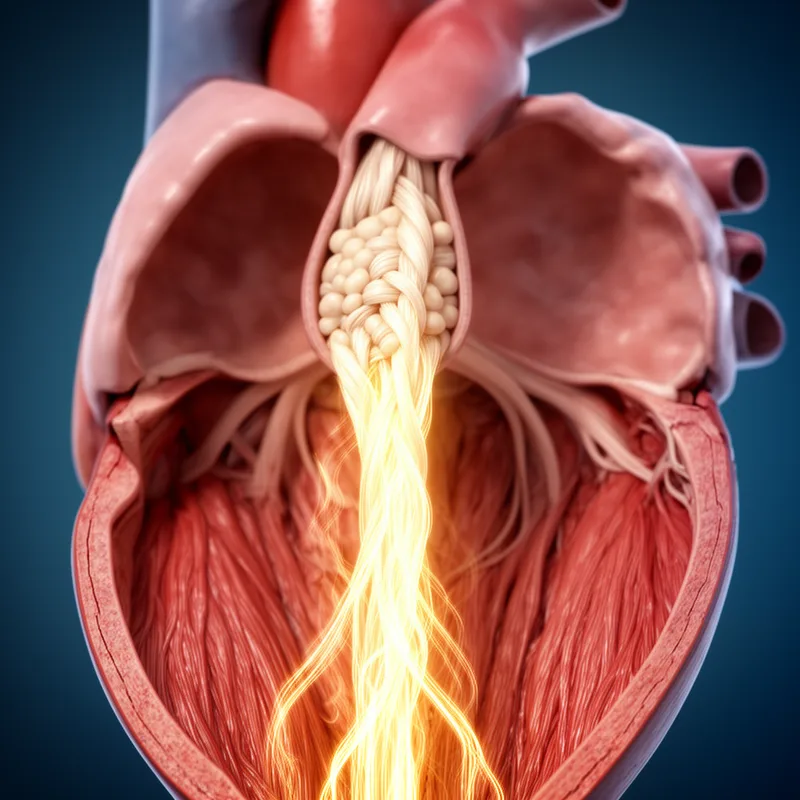
atrioventricular trunk
- noun
- /ˌeɪtriˌoʊvɛnˈtrɪkjʊlər trʌŋk/
- Specialized
- The atrioventricular trunk is essential for coordinating the contraction of the heart's ventricles.
Examples
-
Damage to the atrioventricular trunk can disrupt the normal rhythm of the heartbeat.
-
Doctors studied the function of the atrioventricular trunk in patients with cardiac arrhythmias.
-
The atrioventricular trunk plays a crucial role in heart function.
-
An atrioventricular trunk is essential for coordinating heartbeats.
-
Damage to the atrioventricular trunk can disrupt the normal rhythm of the heartbeat.
-
Doctors studied the function of the atrioventricular trunk in patients with cardiac arrhythmias.
-
The atrioventricular trunk is essential for coordinating the contraction of the heart's ventricles.
Synonyms

Muscle fibers in the heart that send electrical signals from the upper heart to lower chambers so they contract

A group of heart fibers that carry signals from the AV node to ventricles, making them contract

A group of heart fibres that carry electrical signals from the heart's top to its lower chambers so they contract

A network of fibers in the heart that send signals to the lower chambers to make them contract

A network of special heart fibers that carry electrical signals to make the lower heart chambers beat
Surface Forms
Morphology
The term combines 'atrioventricular' (involving the atria and ventricles) with 'trunk' (a main stem or central structure), so a learner who knows both constituents can infer it denotes a principal anatomical structure connecting or relating the atria and ventricles. However, the specific electrophysiological role as a bundle of conducting fibers transmitting impulses is specialized medical information not fully predictable from the parts, making the expression only partially transparent.
Etymology
Atrioventricular trunk paints a clear picture: a main trunk that carries an electrical message from the upper chambers (atria) down to the lower chambers (ventricles). So, because this bundle really 'sends a signal' that makes the ventricles 'contract', the name explains its job in the heartbeat.

