

astatic galvanometer
- noun
- /æˈsteɪtɪk ˌɡælvəˈnɑːmɪtər/
- Specialized
- The astatic galvanometer is used in experiments where the Earth's magnetic field must be neutralized.
Examples
-
The astatic galvanometer measures small currents accurately.
-
Unlike ordinary galvanometers, an astatic galvanometer is much less affected by environmental magnetic disturbances.
-
Researchers selected an astatic galvanometer to improve the accuracy of their sensitive measurements.
-
An astatic galvanometer is essential for precise measurements.
-
In physics laboratories, an astatic galvanometer is often used to obtain precise measurements unaffected by external magnetic fields.
-
Scientists preferred an astatic galvanometer because it provided reliable readings even in areas with significant magnetic interference.
-
To measure tiny electrical currents, engineers frequently employ an astatic galvanometer that cancels out the Earth's magnetic influence.
Synonyms
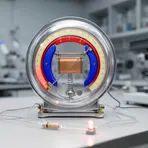
An instrument that measures very small electric current using a coil that moves in a magnetic field

A device that measures very small electric currents
Surface Forms
Morphology
astatic + galvanometer
Although morphologically it is just adjective + noun, the adjective 'astatic' is a rare technical term (not attested in the provided dictionary) whose meaning—relating to canceling the Earth's magnetic field—is not predictable from common knowledge of 'a-' or 'static'. A B1 learner who knows 'galvanometer' but not this specialized adjective would not be able to infer the specific technical sense, so the phrase is effectively opaque to such learners.
Etymology
Astatic galvanometer gets its name from astatic and galvanometer: imagine two small magnets or wire loops placed to pull in opposite directions so the Earth's steady magnetic pull is cancelled. Because 'astatic' means 'not fixed' in this setup, the instrument is 'not affected by' the Earth's magnetic field and so can measure very small electric currents accurately.

