
associative aphasia
- noun
- /əˈsoʊʃiˌeɪtɪv əˈfeɪʒə/
- Specialized
- The patient diagnosed with associative aphasia was unable to repeat simple sentences spoken to him.
Examples
-
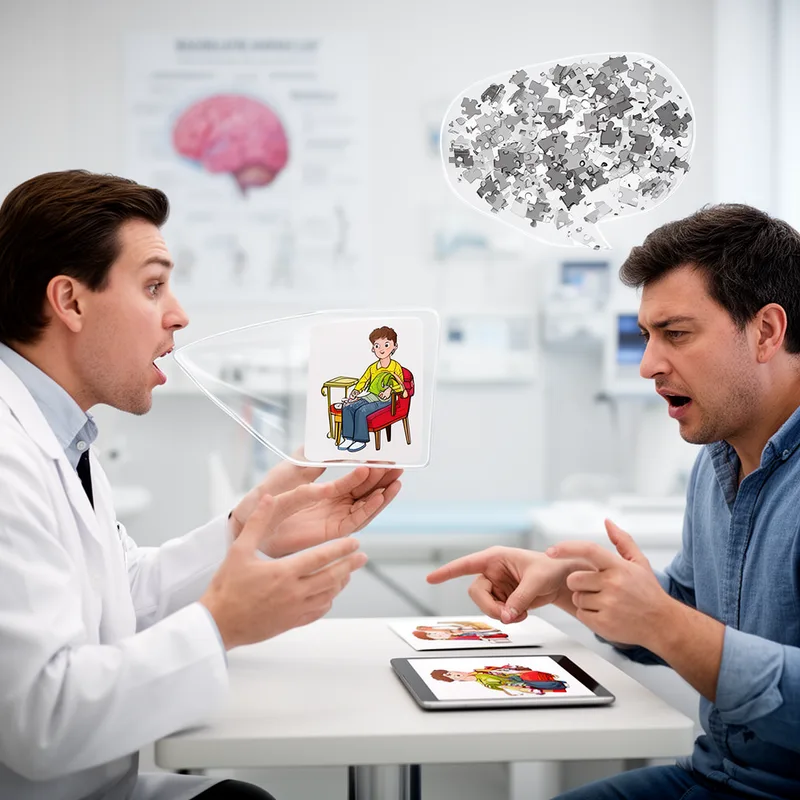
Individuals with associative aphasia may find it hard to repeat spoken words, even though they can comprehend them.
-
The patient diagnosed with associative aphasia struggled to repeat the instructions given by the speech therapist.
-
Neurologists suspect associative aphasia when repetition is specifically impaired, but comprehension remains intact.
-
Treatment for associative aphasia focuses on improving the brain's ability to process and relay spoken language.
-
John was diagnosed with associative aphasia after his stroke.
-
Patients with associative aphasia struggle to repeat phrases accurately.
-
Neurologists suspect associative aphasia when patients show difficulty in repeating sentences while understanding language.
Synonyms



 1
7.8
1
7.8
A speech problem where a person speaks fluently but cannot repeat words or sentences because of brain damage
Surface Forms
Morphology
The term combines 'associative' (relating to linking) and 'aphasia' (loss of language), so a learner who knows both words can infer it refers to a form of language impairment involving associative processes. However, the specific clinical details (e.g. repetition difficulty and lesion location) are specialized and not predictable from the constituents, making the overall meaning only partly transparent.
Etymology
Associative aphasia combines associative, which points to the brain 'links', and aphasia, meaning a loss of language. Imagine two rooms with a small bridge between them: words can be heard and understood in one room but cannot cross the broken bridge to be spoken in the other. So, the name explains why a person can 'understand' speech but cannot 'repeat' it.