
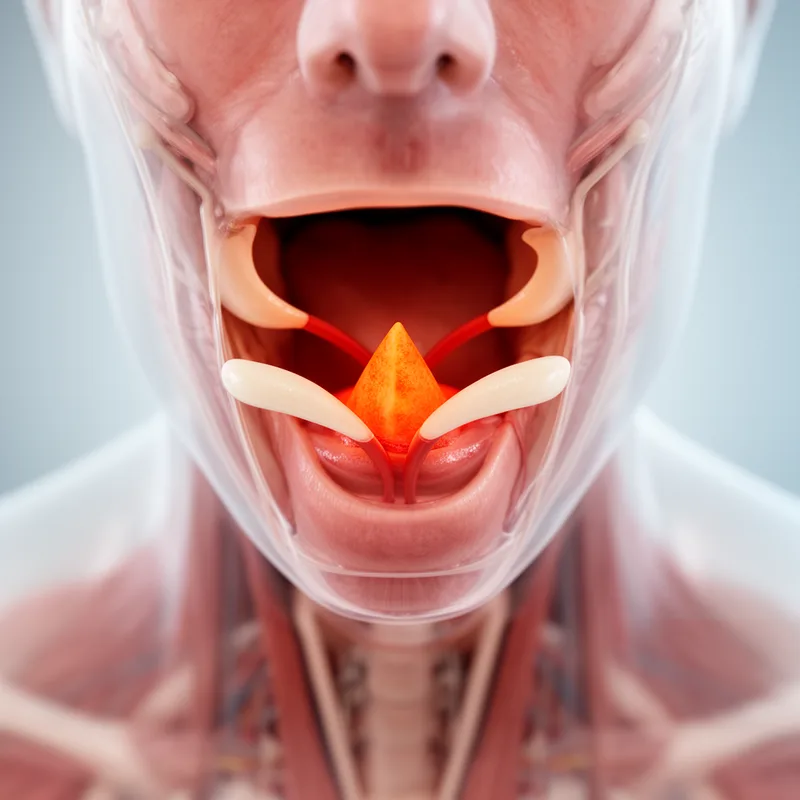
arytenoid cartilage
- noun
- /ˌɛrɪˈtiːnɔɪd ˈkɑːrtɪlɪdʒ/
- Specialized
- The arytenoid cartilage plays a crucial role in the mechanism of voice production as it anchors the vocal folds.
Examples
-
Examination of the larynx revealed edema of the right arytenoid cartilage; the right wall of the larynx still contained a bulge, and the left vocal fold was still fixed.
Academic text (2001) -
The right arytenoid cartilage was heavily involved and fixed.
Academic text (1996) -
The surgeon carefully examined the arytenoid cartilage for any signs of damage during the procedure.
-
Inflammation of the arytenoid cartilage can lead to difficulties in speaking and breathing.
Synonyms

A small cartilage at the back of the voice box to which the vocal cords attach

One of two small pieces of firm tissue at the back of the voice box that hold the vocal cords
Surface Forms
Morphology
The phrase denotes the cartilage that is 'arytenoid' and is compositionally built from 'arytenoid' (the specific anatomical element) + 'cartilage' (connective tissue). This is a straightforward noun–noun anatomical naming pattern common across languages, so a learner who knows both constituent meanings would readily infer the MWE meaning.
Etymology
Arytenoid cartilage may come from a Greek word for 'ladle' because each small arytenoid piece of cartilage looks like a tiny spoon or cup. That's why the name fits these little parts at the back of the 'voice box' where the vocal cords attach.

