

arytenoid
- noun
- /ˌɛrɪˈtiːnɔɪd/
- Specialized
 :
aritenoides
:
aritenoides
- The arytenoid cartilages play a crucial role in adjusting the tension of the vocal cords.
- arytenoid palpation
- arytenoid fold
Examples
-
During the surgery, the doctor carefully examined the arytenoid to ensure it was functioning properly.
-
The aryepiglottic folds and the arytenoids were normal on X-ray.
Academic text (2005) -
The scar tissue and the right arytenoid were removed.
Academic text (1996) -
When one arytenoid was pushed laterally, the other moved medially.
Academic text (2006) -
The hemangioma involved the left arytenoid and aryepiglottic fold.
Academic text (2006) -
Ultimately, our technique of office-based palpation of the arytenoids can be used as part of the initial evaluation.
Academic text (2006) -
The arytenoids displayed minimal mobility on simultaneous passive movement.
Academic text (2006) -
Arytenoid palpation and examination of the posterior glottis were required to complete the evaluation.
Academic text (2006) -
Both arytenoids are palpated, and a lateral excursion is attempted.
Academic text (2006) -
If the history does not suggest a probable cause, it is best to proceed with laryngeal EMG and arytenoid palpation.
Academic text (2006)
Synonyms

A small cartilage at the back of the voice box where a vocal cord attaches
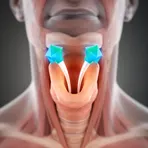
A small cartilage at the back of the voice box to which the vocal cords attach
Compounds
- Specialized
A small cartilage at the back of the voice box where a vocal cord attaches
Surface Forms
Morphology
arytenoid = aryten + oid
The term is a specialised medical formation: the combining form 'aryten-' is not a standalone English word and the suffix '-oid' ('-like') does not help a typical learner infer the specific anatomical meaning.
Etymology
The word arytenoid comes from the Greek word arytaina meaning 'ladle' and the ending -oid meaning 'like'. So an arytenoid is a small, 'ladle-shaped' cartilage at the back of the throat where the vocal cords attach, which helps produce the voice.

