
arthroscopy


 1
7.4
1
7.4
- noun
- /ɑrˈθrɒskəpi/
- Specialized
- With some patients, such as one immediately following knee arthroscopy or an ankle sprain, the therapist's choice is a simple one (see Figure 8).
Examples
-
However, with the advent of arthroscopy, it has become possible to address the intra-articular pathology while allowing the individual a better opportunity to return to athletics.
Academic text (2003) -
Shoulder reconstruction can be performed with an open incision or by arthroscopy.
Academic text (2003) -
So we feel that we can replace almost all of these arthroscopies with the procedures that we're doing.
-
Classification of OA of the CMC joint can be achieved using radiographs or arthroscopy.
Academic text (2011) -
With the advent of arthroscopy, the practitioner now has a less invasive alternative with lower morbidity to offer the young patient with traumatic instability.
Academic text (2003) -
When the clinical history and symptoms are consistent with a focal cartilage injury, after plain radiographs are obtained, arthroscopy may be the next indicated step.
Academic text (2005) -
After 6 months, diagnostic arthroscopy showed extensive synovialitis; microbiology was positive, showing methicillin-sensitive Staphylococcus aureus.
Academic text (2007) -
Arthroscopy now accounts for 90 percent of all arthroscopies performed in the U.S.
-
Some pro football players have multiple arthroscopies, at times as many as 10.
-
More than 650,000 knee arthroscopies are performed annually.
How Invasive
- Specialized

- Specialized
1
7.4
Surface Forms
Morphology
arthroscopy = arthroscope (opaque) = arthro + scopy
Although formed from medical combining forms ('arthro-' meaning joint + '-scopy' meaning examination), these elements are not common standalone English words and the term is technical, so a B1 learner would not reliably infer the meaning.
Etymology
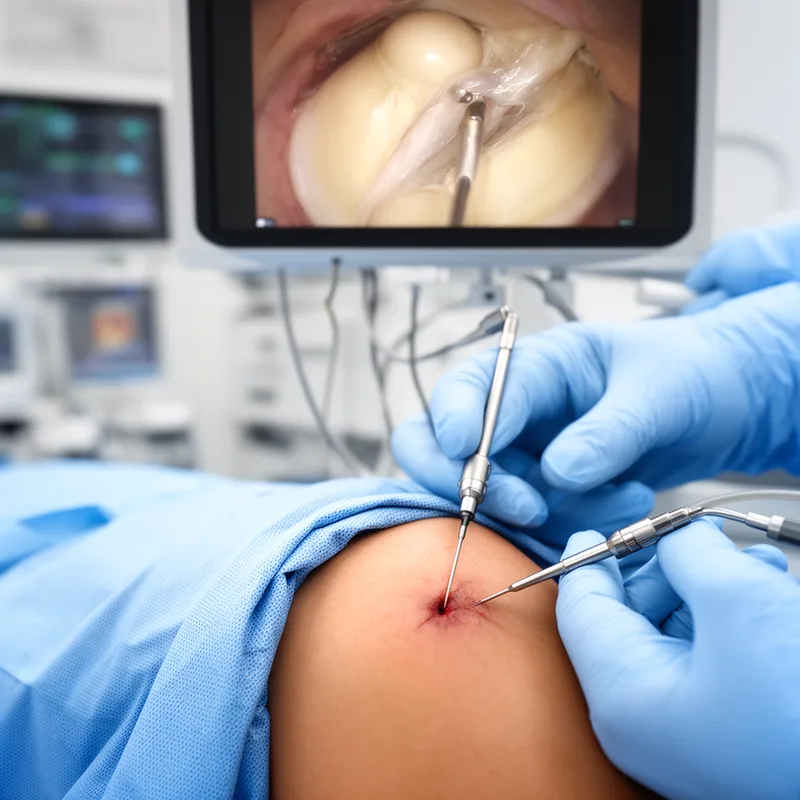
Arthroscopy comes from Greek parts arthro- meaning 'joint' and -scopy meaning 'to look', like in telescope. So an arthroscopy is literally 'looking into a joint', which is why doctors use a small camera through a tiny cut to examine and treat the joint.