
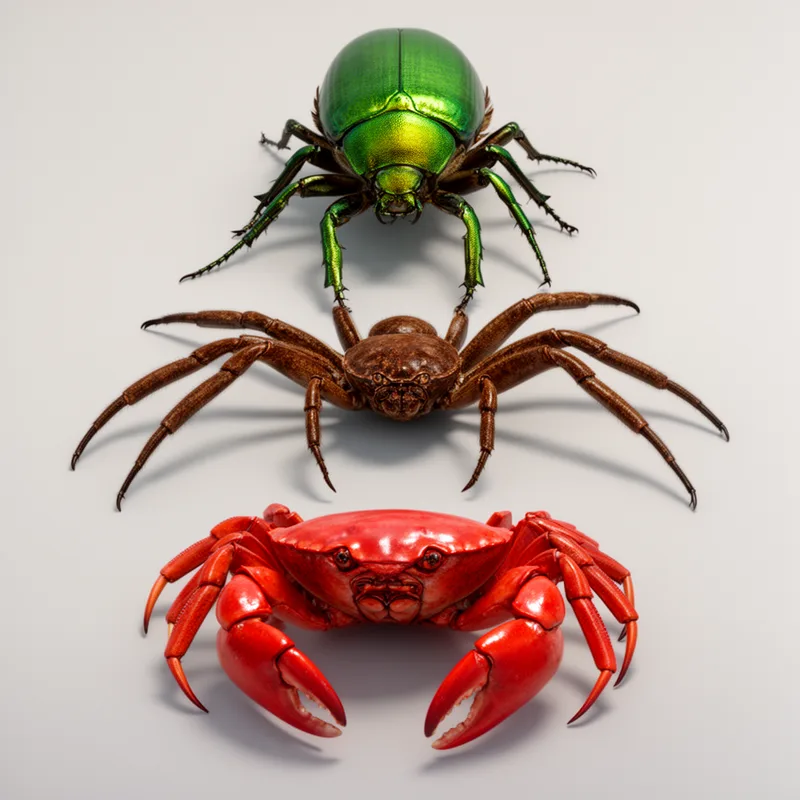
arthropodal


 1
9.9
- adjective
- /ˌɑrθrəˈpoʊdəl/
- Specialized
- The researcher studied the arthropodal characteristics shared by insects and spiders.
Examples
-
The arthropodal features of the insect were fascinating.
-
Some textbooks feature detailed diagrams of arthropodal anatomy for educational purposes.
-
Crustaceans exhibit a wide variety of arthropodal adaptations to aquatic environments.
-
Many arthropodal species can adapt to extreme environments.
-
The scientist studied an arthropodal species to understand its unique adaptation to the environment.
-
Many arthropodal creatures, including spiders and crabs, have exoskeletons that protect them.
-
In the aquarium, we observed various arthropodal animals, such as shrimp and lobsters.
Synonyms
Relating to animals like insects, spiders and crabs that have a hard outer shell and many legs
Relating to animals without backbones that have jointed legs and a hard outer shell like insects or crabs
Surface Forms
Morphology
arthropodal = arthropod (transparent) = arthro + pod + al
The adjective is a regular -al derivative of the technical noun 'arthropod', so the meaning is straightforward if the base noun is known.
Etymology
Arthropodal comes from Greek parts arthro- meaning 'joint' and -podal meaning 'foot' or 'leg', as in arthritis and tripod. So arthropodal describes animals with 'jointed legs', such as insects, spiders, and crabs.