
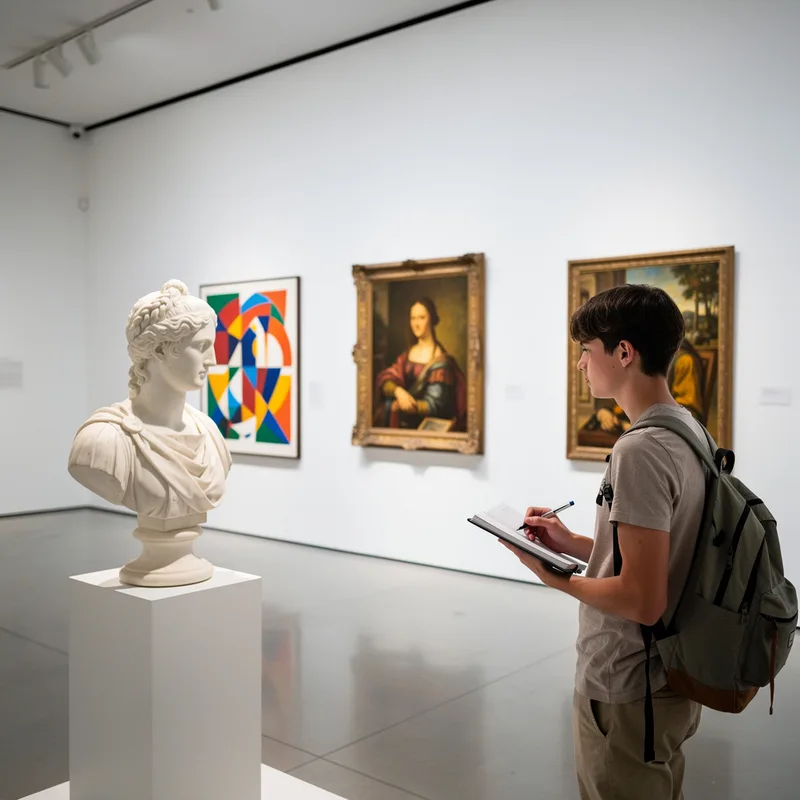
art history
 25
3.7
25
3.7

- noun
- /ɑrt ˈhɪstəri/
- In my art history class, we studied the works of Renaissance artists.
- art history and criticism
- art history and aesthetics
- professor of art history
Loading YouTube…
Watch on YouTubeYou're going to do study groups and study for those art history exams together, you know?
- You're going to do study groups and study for those art history exams together, you know?
- It may be that the distinction is between learning about cities through art history.
- But I, when I was at USCI, studied Asian art history for one of my general requirement classes.
- It was very tied to just academia and where women stand in art history.
- I wanted to start the lecture today by addressing a question that I'm very frequently asked, which is why do you study art and art history?
- Like, there's a reason why the Renaissance is still graded as the greatest history in art history.
Examples
-
Well, I've got a degree in art and a background in art history, and I've worked for the museum and some photographers.
-
Oh, I recognize that from my art history books.
-
I finally get to use my art history degree.
-
There is a girl in your art history class.
-
We learned about it in art history.
-
"I was surprised when my daughter chose to go into art history and not medicine."
Fiction book (1999) -
Before marriage to my father, she'd studied art history for a year in France.
Fiction book (1999) -
She's in the art history class too.
-
Amy Freund is an assistant professor of art history at Texas Christian University.
Academic text (2011) -
Rebecca Zorach is an associate professor of art history at the University of Chicago.
Academic text (2011)
Surface Forms
Morphology
The meaning 'the history of art' is directly compositional from 'art' (visual artistic works) + 'history' (the study of past developments), so a learner who knows both words can infer the MWE. This noun–noun compound pattern is cross-linguistically common (e.g., Spanish 'historia del arte'), making it immediately comprehensible to a B1 learner.
Etymology
Art history joins art (paintings, sculpture and other visual work) and history (stories about the past). It creates the image of looking at old artworks and following their story through time, so it means 'the study of how art developed'.