
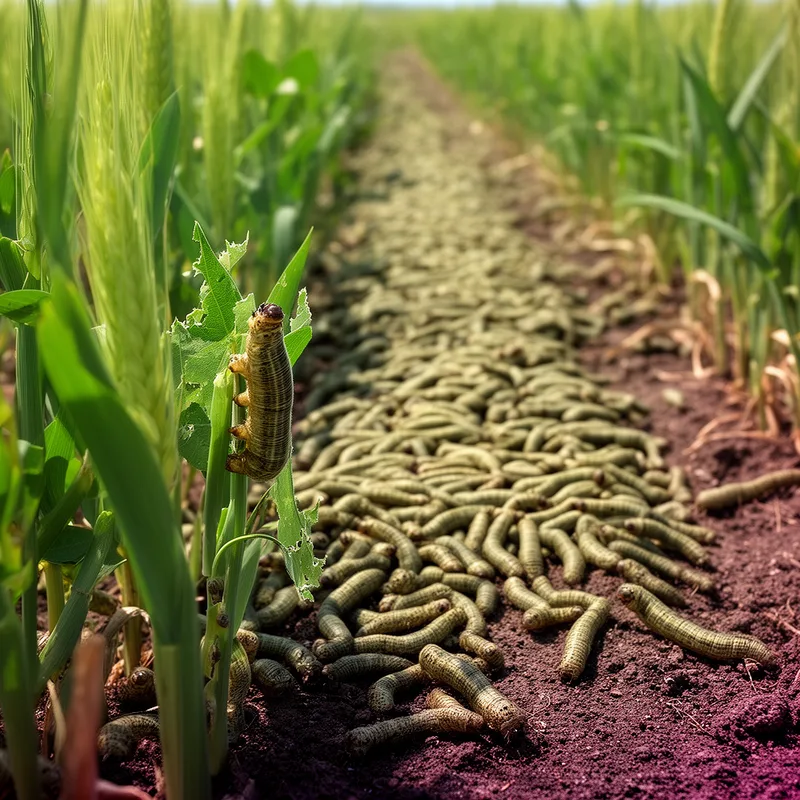
army cutworm
- noun
- /ˈɑrmi ˈkʌtˌwɜrm/
- Specialized
 :
gusano cortador del ejército
:
gusano cortador del ejército
- The army cutworm can devastate entire fields of wheat if not controlled early.
Examples
-
Researchers are developing new methods to monitor army cutworm populations in alfalfa crops.
-
The army cutworm is known for its destructive behavior.
-
Farmers in the Midwest worry about army cutworm outbreaks each spring.
-
Farmers in Nebraska often deal with army cutworms during the spring.
-
The army cutworm can devastate alfalfa fields when it migrates in large numbers.
-
Farmers in the Midwest often battle the army cutworm to protect their grain crops.
-
During late summer, the army cutworm larvae can be found in vast swarms in cornfields.
Synonyms

A moth whose caterpillars, called armyworms, travel in large groups and eat grain and alfalfa crops

A caterpillar that moves in large groups and eats crops like grain

A caterpillar that moves in large groups and eats crops like grass and grain
Surface Forms
Morphology
The compound directly combines 'army' (a large organized group) with 'cutworm' (a caterpillar that cuts seedlings), so the meaning — a type of cutworm that occurs in large, migratory/destructive groups — is inferable from the parts. Using 'army' metaphorically for aggregating insects (cf. armyworm, army ants) is a common, productive pattern in English and many languages, so a B1 learner who knows both constituents can reasonably deduce the MWE meaning.
Etymology
Army cutworm comes from two simple images: the caterpillars move in large, marching groups like an army, and they 'cut' plants at the stem as they eat, like other cutworms. That's why the name refers to the caterpillar that travels in big numbers and can destroy crops.

