
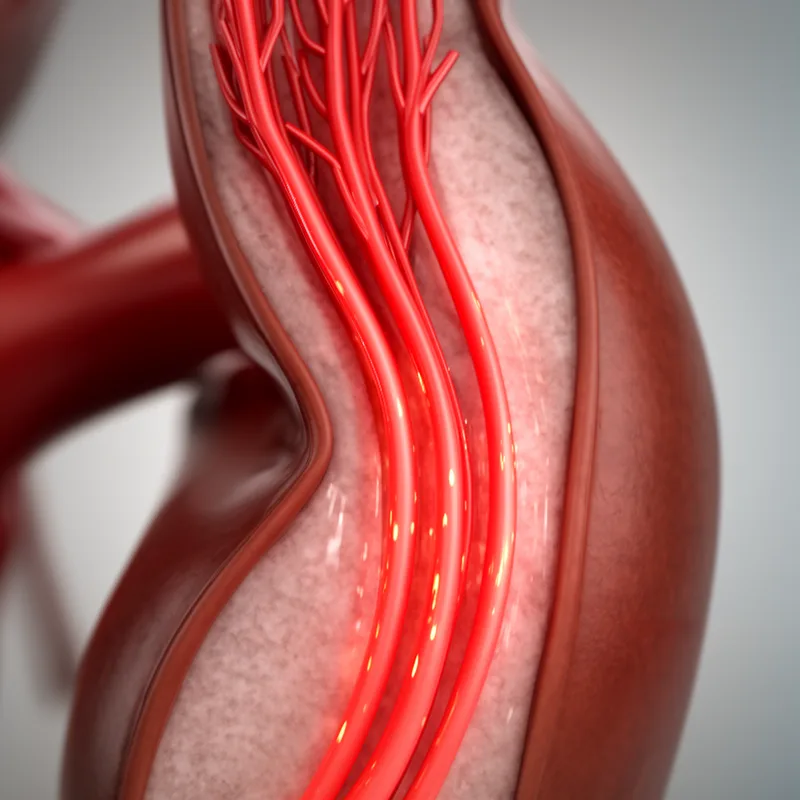
arcuate artery of the kidney
- noun
- /ˈɑrkjʊˌeɪt ˈɑrtəri əv ðə ˈkɪdni/
- Specialized
- The arcuate artery of the kidney runs along the border between the cortex and the medulla.
Examples
-
The arcuate artery of the kidney is essential for delivering oxygen-rich blood to renal tissues.
-
Each arcuate artery of the kidney branches off from the renal artery.
-
Damage to the arcuate artery of the kidney can affect blood flow within the organ.
-
Each arcuate artery of the kidney gives rise to several interlobular arteries.
-
The arcuate artery of the kidney plays a crucial role in renal blood supply.
-
Surgical intervention may be required if the arcuate artery of the kidney becomes blocked.
-
An anatomical study revealed that the arcuate artery of the kidney is located at the junction of the cortex and medulla.
Surface Forms
Morphology
arcuate + artery + of + the + kidney
The phrase is a straightforward compositional noun phrase: 'arcuate' (curved) + 'artery' (blood vessel) + 'of the kidney' (located in the kidney) yields the meaning of a curved blood vessel in the kidney. While it is technical and a B1 learner may not know precise anatomical landmarks (cortex/medulla), the core meaning is directly derivable from the constituents.
Etymology
Arcuate artery of the kidney is named after the word arcuate, which comes from a Latin word for a 'bow' or 'arch', and artery means a blood vessel. These blood vessels run in curved lines like small arches along the border between the kidney's outer and inner parts, so the name shows they are the curved arteries that 'supply blood' there.

