
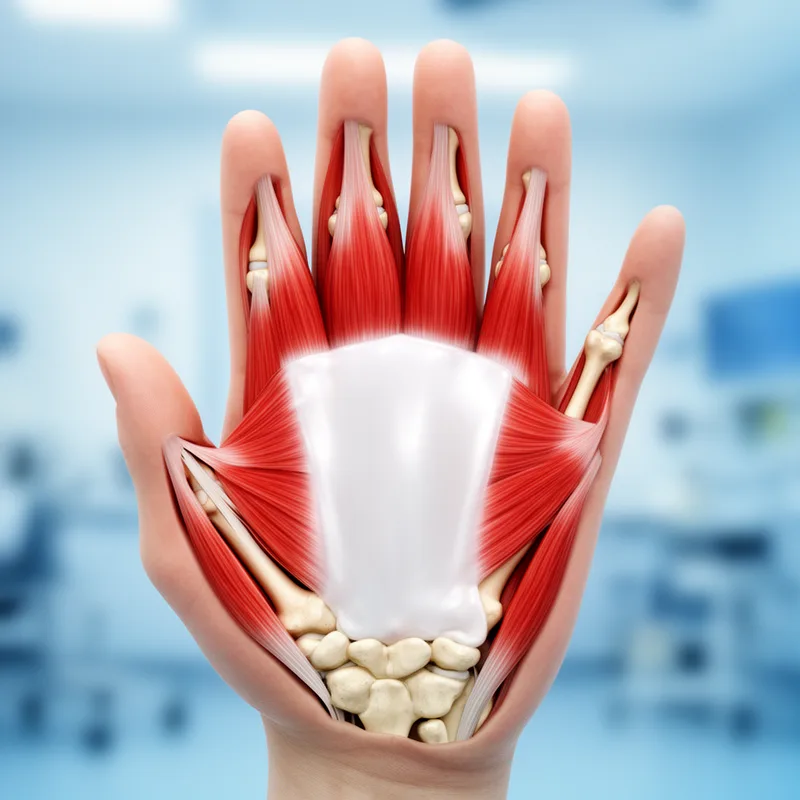
aponeurosis


 1
9.9
- noun
- /ˌæpəˈnʊəroʊsɪs/
- Specialized
- The surgeon explained that the aponeurosis acts like a strong sheet, holding the muscle in place.
Examples
-
However, the planter strap of the bony endoskeleton foot with its five rays (Figure 2) more closely corresponds to the planter aponeurosis (Figure 10) than does the "planter fascial strap" of the SAFE foot.
Academic text (1991) -
The aponeurosis connects the muscle to the bone, allowing for movement.
-
Sternocleidomastoid muscle thickness is defined as the distance from the superficial to the deep aponeurosis in the thickest part of the muscle.
Academic text (2015) -
In anatomy class, we learned about the aponeurosis that supports various muscles in the body.
Surface Forms
Morphology
aponeurosis = apo + neur + osis
This is a learned Greek medical borrowing built from classical elements, but the parts are not transparent enough for an average learner to predict the modern anatomical meaning.
Etymology
Aponeurosis comes from Greek parts apo- 'away from' and neuron 'sinew' or 'tendon'. Think of it as a 'sinew spread away' — a flat, sheet-like tendon that spreads out to connect muscle to bone, which is why an aponeurosis is a wide, thin tendon rather than a round cord.