

apodiform bird
- noun
- /ˈæpədɪˌfɔrm bɜrd/
- Specialized
 :
ave apodiforme
:
ave apodiforme
- The apodiform bird family includes both hummingbirds and swifts, known for their aerial skills.
Examples
-
Swifts are a common example of an apodiform bird seen gliding across the evening sky.
-
Many species of apodiform birds migrate during the winter.
-
An apodiform bird spends much of its life in flight, rarely perching on the ground.
-
The apodiform bird soared gracefully through the sky.
-
Swifts are a common example of an apodiform bird seen gliding across the evening sky.
-
An apodiform bird spends much of its life in flight, rarely perching on the ground.
-
The apodiform bird family includes both hummingbirds and swifts, known for their aerial skills.
Synonyms

 ∞
1.0
∞
1.0

A warm-blooded animal with feathers, wings, and a beak that usually flies
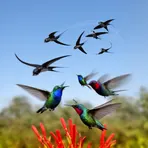
A group of small birds like swifts and hummingbirds that fly very fast

A group of birds that includes swifts and hummingbirds
How Aerial

Surface Forms
Morphology
apodiform + bird
This is a straightforward adjective+noun combination: 'apodiform' describes a particular type of bird and 'bird' names the animal class, so the meaning is compositionally derived as 'a bird that is apodiform' (i.e. nonpasserine with long wings, weak feet, often in flight). Although 'apodiform' is specialized vocabulary, there is no idiomatic or metaphorical shift, so a learner who knows both constituent meanings can infer the phrase.
Etymology
Apodiform bird comes from old word parts a- and pod meaning 'without' and 'foot'. Because these birds have very small, weak feet and spend most of their lives flying, the name explains why they seem almost 'footless' and are known for living in the air.