

apoapsis
- noun
- /ˌæpoʊˈæpsɪs/
- Specialized
- Then, as we go out to apoapsis—the point in the orbit farthest from the surface—we turn the antenna toward Earth and play back the data.
Examples
-
At apoapsis, the satellite will be 1,000 kilometers away from the Earth.
-
Astronomers measure the distance to the planet's apoapsis to calculate its orbital characteristics.
-
The spacecraft reached its apoapsis, allowing it to gather data from a longer distance.
Synonyms
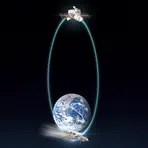
The point in an orbit that is farthest from the planet or star it goes around

The point in an orbit when a star or planet is farthest from the object it goes around
Antonyms

- Specialized
The point in an object's orbit when it is closest to the body it goes around
Compounds
- Specialized
The point in an orbit that is farthest from the planet or star it goes around
How Close
- Specialized

- Specialized
Surface Forms
Morphology
apoapsis = apsis (semi-transparent) = apo + apsis
The form is a straightforward combination apo- + apsis used in technical astronomy, but both elements are specialised combining forms unlikely to be known by average learners.
Etymology
Apoapsis comes from the Greek parts apo- meaning 'away from' and apsis meaning 'arch' or 'loop'. So apoapsis names the point in an orbit that is 'away from' the body it circles — the farthest point, like the better-known word apogee.

