
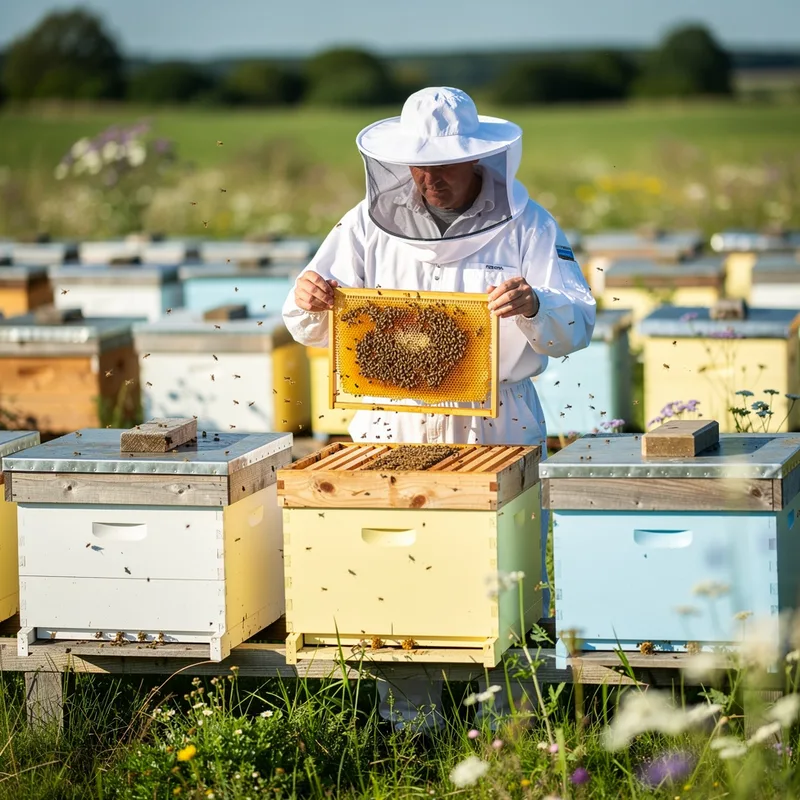
apiary
 4
9.1
4
9.1

- noun
- /ˈeɪpiˌɛri/
- Specialized
- In the apiary, beekeepers carefully checked the hives for any signs of disease.
- bees in the apiary
Examples
-
To monitor the managed honey bee population, ARS personnel visit 12 to 18 apiaries scattered across the Mexican states of Tamaulipas and Nuevo León twice a year.
Academic text (1996) -
But Texas beekeepers are now having to deal with the intrusion of Africanized bees in their apiaries.
Academic text (1996) -
Nearby, there was an apiary.
-
Did Mr Healy not come by to take care of the apiary whilst I was gone?
-
I've already seen to the apiary.
-
There are his footprints from the apiary to the nest and back.
-
Sometimes, around lunchtime, Uncle Julius would take me to his apiary.
Fiction book (1998) -
Eischen maintains an apiary in a remote part of southern Texas.
Academic text (2004) -
The scientists populated the apiaries with survivors from hives that had not been treated with mite-controlling chemicals or miticides.
Academic text (1999) -
When ARS scientists began their monitoring of apiaries, beekeepers in Mexico were leery about letting them gather samples.
Academic text (1996)
Synonyms

A shed that holds many beehives
A place where people raise and study insects like butterflies or beetles
How Big
- Specialized
4
9.1
 52
1.0
52
1.0
Surface Forms
Morphology
apiary = api + ary
The element 'api-' is a Latin combining form for 'bee' that is not a standalone English word, so learners cannot transparently derive 'apiary' as 'place of bees' without etymological knowledge.
Etymology
Apiary comes from the Latin word apis, meaning 'bee', and the ending -ary comes from Latin -arium, a part that shows a 'place'. So an apiary is literally a 'place of bees', which is why the word means where beehives are kept.