
antiphase
- noun
- /ˈæntɪfeɪz/
- Specialized
 :
antifase
:
antifase
- The two signals were perfectly antiphase, leading to a complete reduction in the overall amplitude.
- antiphase coordination
- phase and antiphase
Examples
-
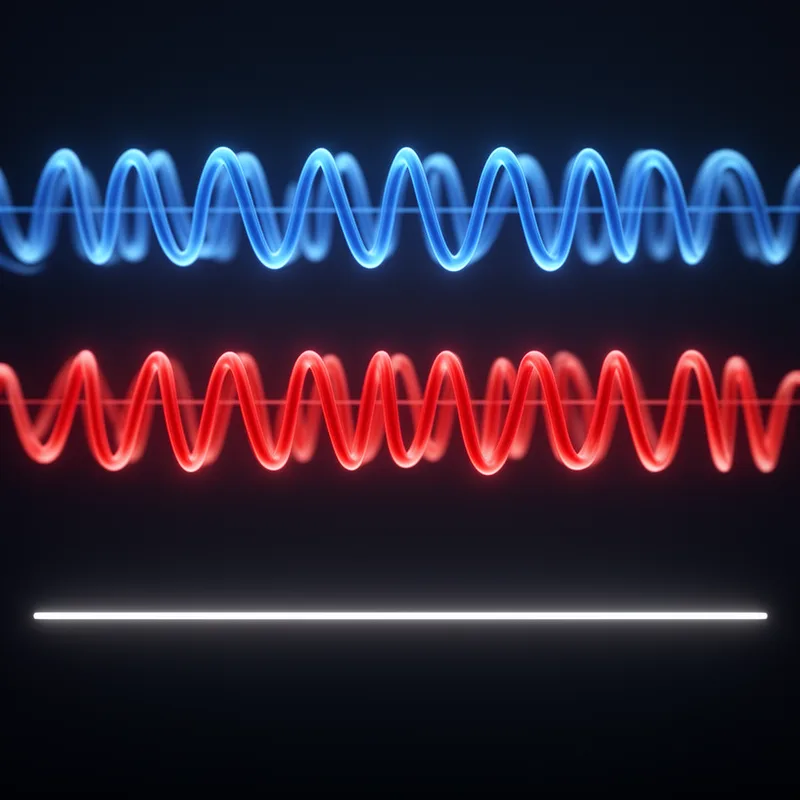
When sound waves travel in antiphase, they cancel each other out, resulting in silence.
-
In particular, the most recent temperature oscillations in Greenland between 16,000 and 11,000 years ago are in antiphase with those observed in central Antarctica.
Academic text (2002) -
The two independent subsystems are set in antiphase motion to begin with, and then X3 is introduced at about repetition 35 of the cycle.
Academic text (2006) -
The hemispheres respond in antiphase with a see-saw redistribution of heat due to large and rapid changes in ocean currents.
Blog text (15) -
The two forms of coupling generally result in either in-phase (bottom left) or antiphase (bottom right) coordination of the oscillators.
Academic text (2006) -
And if there is the slightest connection between the two resources, say through very weak competition, the system would be driven back into its antiphase-coordinated state (Vandermeer 2004).
Academic text (2006) -
There is no inherent reason why X3 needs to be either in-phase or antiphase coordinated with either X1 or X2, which leads to the possibility that the two main systems could be in-phase coordinated, thus leaving a space for the third species to invade.
Academic text (2006) -
A useful metaphor for this phenomenon is the coupled oscillating pendulum model, in which it is easy to see how either in-phase or antiphase coordination is driven by the specific nature of the coupling (Figure 2c).
Academic text (2006) -
To achieve optimal performance, the devices must operate in antiphase to minimize interference.
Surface Forms
Morphology
Etymology
Antiphase comes from anti- 'against' and phase 'stage'. It names the state when two waves are exactly opposite so their highs meet lows and they cancel each other out, which explains why antiphase means a condition of reduction or cancellation.

