
antineutrino
 1
9.9

- noun
- /ˌæntiˈnjuːtraɪnoʊ/
- Specialized
- In a beta decay reaction, an electron is produced along with an antineutrino as part of the process.
- electron antineutrino
Examples
-
When the electron antineutrino collided with a proton in the water, the positron was slowed down by the water, and then it was annihilated with an electron to produce two 0.51-MeV photons.
Academic text (1995) -
The high electron-antineutrino flux, 10^13 per square centimeter per second, and the reduced cosmic-ray background underground were both crucial for the experiment to succeed.
Academic text (1995) -
Meanwhile, the W boson quickly turns into an electron and an antineutrino, both of which typically escape.
Academic text (2012) -
The discovery of the electron antineutrino by Frederick Reines and Clyde Cowan required still different technology.
Academic text (1997) -
They showed that the electron antineutrino existed by using a nuclear reactor and large liquid scintillation counters.
Academic text (1997) -
In 2005, an excess of low-energy antineutrinos above background was reported by KamLAND, a Japan-US collaboration operating a similar detector in the Kamioka mine in Japan.
Blog text (28) -
The academy commends Reines and the late Clyde L. Cowan Jr. for their pioneering contributions during the 1950s that led to their being able to demonstrate experimentally the existence of the antineutrino of the electron.
Academic text (1995) -
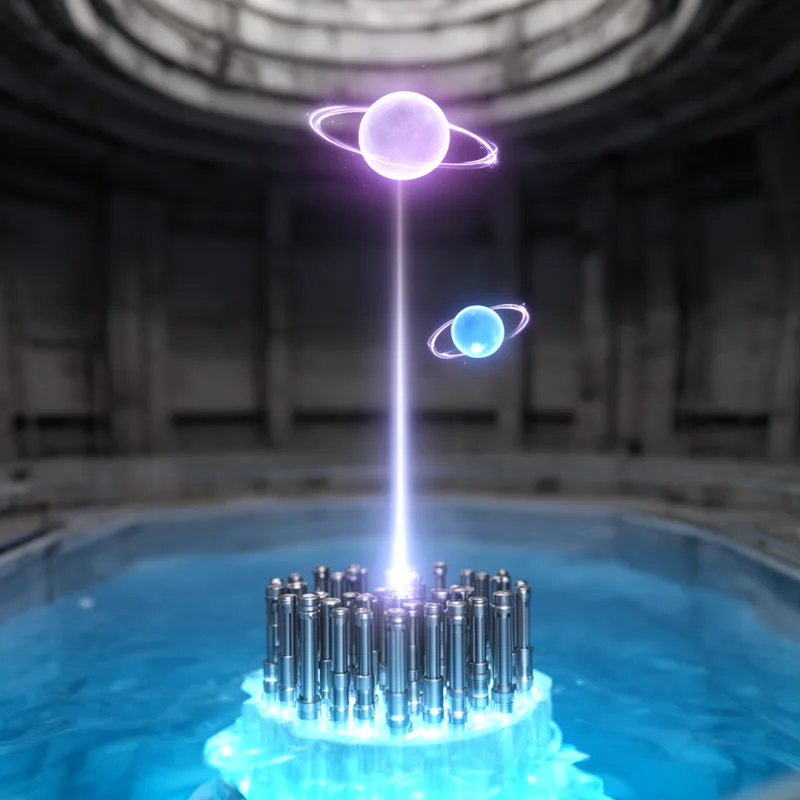
Researchers detected an antineutrino emitted from the reactor during their experiments to understand particle interactions.
-
The experiment aimed to measure the properties of the antineutrino to confirm hypotheses about subatomic particles.
Surface Forms
Morphology
Etymology
Antineutrino breaks into anti- 'opposite' and neutrino, a word from Italian meaning 'little neutral one' and related to English neutral 'not charged'. So an antineutrino is the particle that is the opposite partner of a neutrino, with the same mass but opposite properties.