
antiferromagnetic


 1
9.9
- adjective
- /ˌæntifɛrəmæɡˈnɛtɪk/
- Specialized
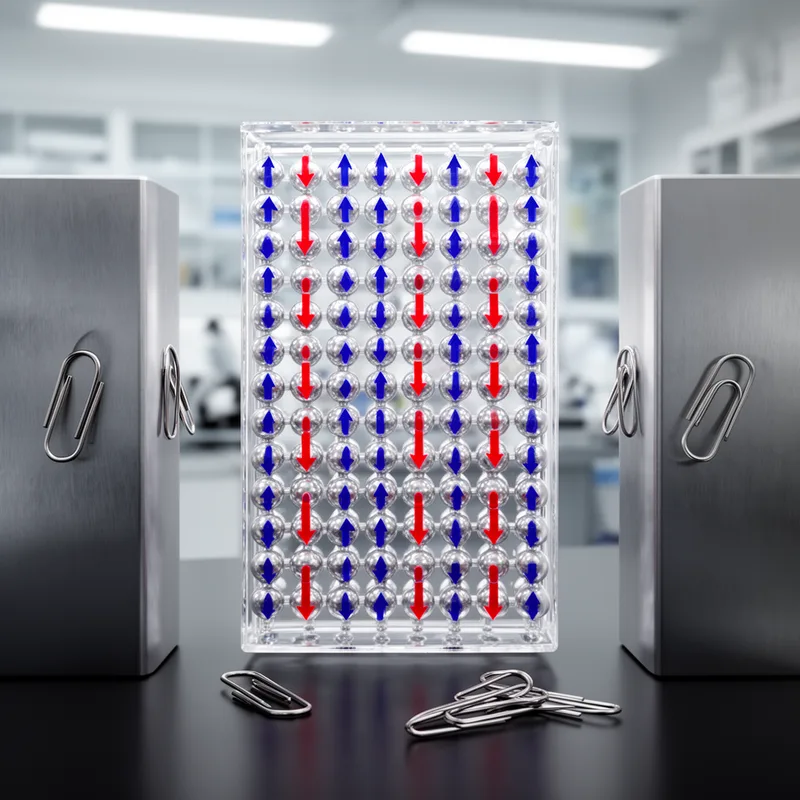
- In this magnet, adjacent ions are antiferromagnetic, resulting in no overall magnetic field despite their aligned moments.
- antiferromagnetic ordering temperature
- antiferromagnetic order
Examples
-
In other words, during the hydrocarbon hydroxylation reaction by MMO, one may expect spin-crossing of the system and switching between antiferromagnetic and ferromagnetic couplings among the expected intermediates and transition states.
Academic text (2001) -
The result is a kind of antiferromagnetic, one-dimensional crystal, consisting of alternating planes of atoms with opposite magnetization.
Academic text (1994) -
Thus, the salient energy scales for antiferromagnetic order and superconductivity can be varied over a wide range and examined in two very different limits: T_c > T_N and T_c < T_N.
Academic text (1998) -
In the case of HoNi2B2C and DyNi2B2C, the Ho and Dy moments are virtually the same (in magnitude and anisotropy) and they order magnetically at low temperatures with the same simple antiferromagnetic structure.
Academic text (1998) -
The researchers discovered an antiferromagnetic material that had unique properties at low temperatures.
-
Understanding the antiferromagnetic behavior of certain crystals can lead to advances in quantum computing technologies.
Surface Forms
Morphology
antiferromagnetic = ferromagnetic (opaque) = anti + ferro + magnet + ic
The word is formed by standard prefixation to the scientific adjective 'ferromagnetic', but the meaning is specialized and not fully accessible to an average learner without domain knowledge.
Etymology
Antiferromagnetic breaks down into anti- 'against', ferro 'iron', and magnetic 'magnet-like', which gives a clear image. It names materials where tiny, iron-like magnets on neighbouring atoms point in opposite directions and cancel each other, so the material has no overall magnet.