
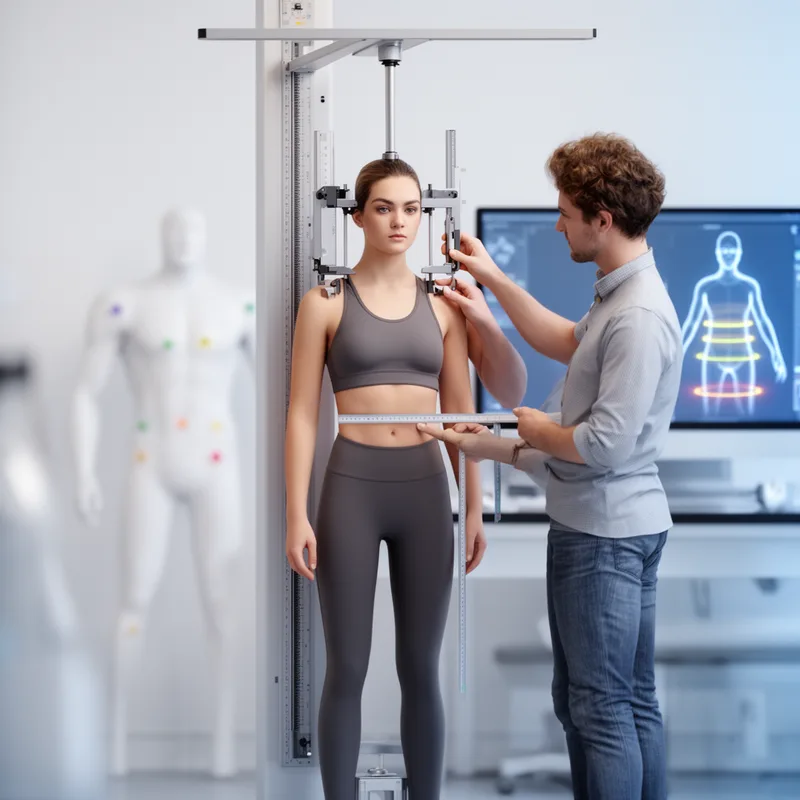
anthropometry


 1
9.4
- noun
- /ˌænθrəˈpɒmətri/
- Specialized
- In her research, she used anthropometry to measure the physical dimensions of the participants' bodies.
- forensic anthropometry
- use of anthropometry
Loading YouTube…
Watch on YouTubeRecords of hospitalizations are available also physical therapy and some basic anthropometry figures.
- Records of hospitalizations are available also physical therapy and some basic anthropometry figures.
Examples
-
Anthropometry is being used more often in determining the sex of skeletal remains.
Academic text (2007) -
The characteristics of the wheelchair (Figure 1) were not adjustable to the anthropometry of the subjects during the tests.
Academic text (1997) -
The use of anthropometry in the field of forensic science.
Academic text (2007) -
Some of the recent studies that employ various techniques of anthropometry are discussed.
Academic text (2007) -
Of these, 18 patients received medical treatment, and their anthropometry was analyzed.
Academic text (2015) -
Precision in anthropometry is of utmost importance as it requires a lot of practice.
Academic text (2007) -
The most common errors in anthropometry are positioning of the body or bones, reading measurements, and recording.
Academic text (2007) -
There were relatively modest differences in anthropometry between offspring who participated in the clinical examination and those who completed the web-based questionnaire only.
Academic text (2012) -
Anthropometry can be subdivided into somatometry, including cephalometry, and osteometry, including craniometry.
Academic text (2007) -
The team collected data on various aspects of anthropometry to improve ergonomic designs.
Surface Forms
Morphology
anthropometry = anthropo + metry
The meaning is directly analyzable as 'anthropo-' (human) + '-metry' (measurement), but both elements are technical combining forms rather than standalone English words, so the composition is only partially transparent to an average B1 learner.
Etymology
Anthropometry comes from Greek parts anthropo- meaning 'human' and -metry meaning 'measure', and you can see anthropo- in anthropology and -metry in thermometer or geometry. So anthropometry is simply 'measuring humans', which is why it means the study of human body measurements.