
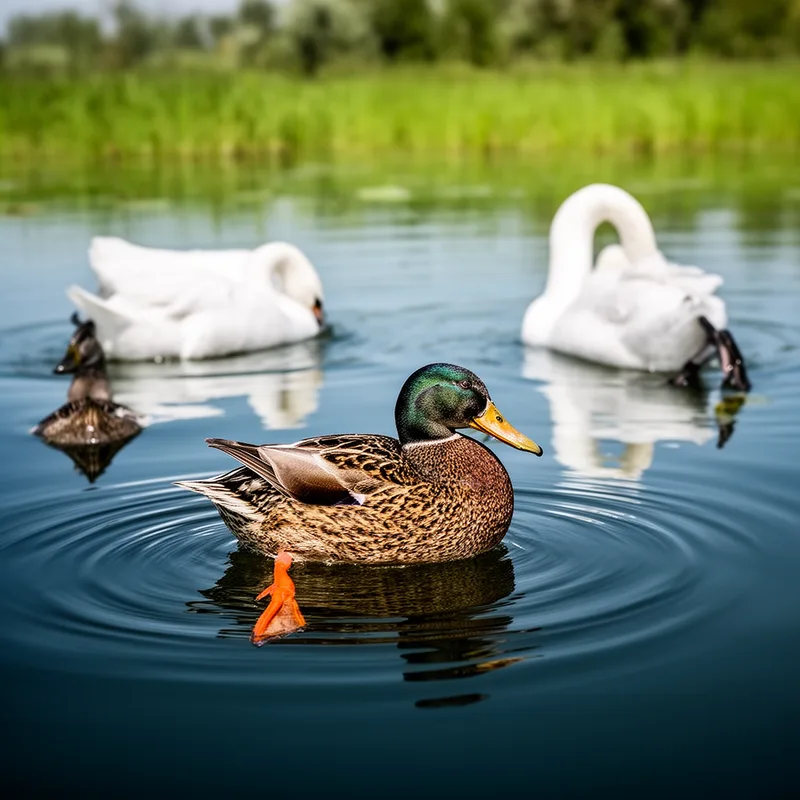
anseriform bird
- noun
- /ˈænsərɪˌfɔrm bɜrd/
- Specialized
- Most anseriform birds have broad, flat bills adapted for dabbling in the water.
Examples
-
The mallard is one of the most widespread anseriform birds in the world.
-
Biologists are studying the migration patterns of several anseriform birds in the wetland region.
-
Biologists are studying the migration patterns of several anseriform birds in the wetland region.
-
Most anseriform birds have broad, flat bills adapted for dabbling in the water.
-
The mallard is one of the most widespread anseriform birds in the world.
-
Look at that beautiful anseriform bird over there!
-
The anseriform bird glided gracefully across the lake.
Synonyms
 12
3.5
12
3.5

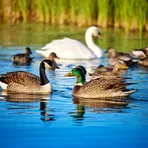
Birds that live near fresh water, like ducks, geese, and swans
 1
2.4
1
2.4
A bird that lives near fresh water and swims or wades
 1
1.7
1
1.7
A bird that lives in or near fresh water like lakes and rivers


 1
3.5
1
3.5
A bird that lives near water and can swim, wade or dive
Surface Forms
Morphology
anseriform + bird
The phrase is directly compositional: 'anseriform' denotes membership in the order Anseriformes (ducks, geese, swans) and 'bird' names the taxonomic class, so the meaning 'a bird of the Anseriformes' is immediately derivable from the parts. Although 'anseriform' is a technical and rare adjective, if a learner knows that constituent the combination is transparent (in practice somewhat redundant because the adjective already implies a bird).
Etymology
Anseriform bird comes from the old word anser meaning 'goose' and the ending -form meaning 'shape' or 'like'. So it pictures a bird 'like a goose' and today it refers to water birds such as ducks, geese, and swans with webbed feet for swimming.