
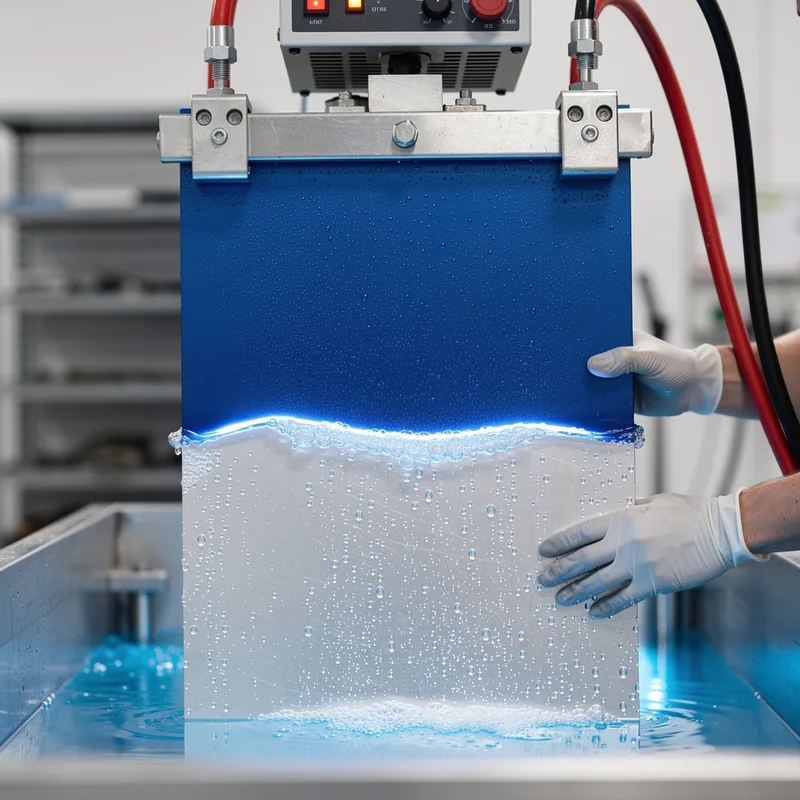
to anodize
 2
8.9
2
8.9

- verb
- /ˈænəˌdaɪz/
- Specialized
- He chose to anodize the bike frame in bright red to give it a unique and stylish look.
- anodized aluminum
- hard-anodized
Loading YouTube…
Watch on YouTubeYeah, that's then I think it's sunblasted, anodized and then laser etched.
- Yeah, that's then I think it's sunblasted, anodized and then laser etched.
Examples
-
The front ring is made of anodized aluminum.
Academic text (2004) -
Low silicon castings can anodize very well, but generally these are few and far between.
Blog text (25) -
Was it too difficult to make it in, say, black anodized aluminum?
Blog text (33) -
The guide blocks are hard-anodized aluminum.
Academic text (1995) -
The iPad mini's anodized aluminum back is generally smooth but not glossy.
Blog text (13) -
The dock is available in three color options and two different materials: anodized aluminum, black anodized aluminum, or hardwood.
Blog text (9) -
The unit's 8-watt UV tube is located near one end of its anodized aluminum cylinder and concentrates all of the UV light where it is needed.
Academic text (2006) -
The engineer decided to anodize the aluminum parts to protect them from corrosion.
-
After the metal was anodized, it had a beautiful, durable surface that was resistant to scratches.
Surface Forms
Morphology
Etymology
Anodize comes from anode, a Greek word that means 'up' or 'upward road'. To anodize is to use electricity so a metal becomes the 'up' side and grows a hard, protective oxide surface, so thinking 'up' can help you remember it makes a strong outer skin on the metal.