
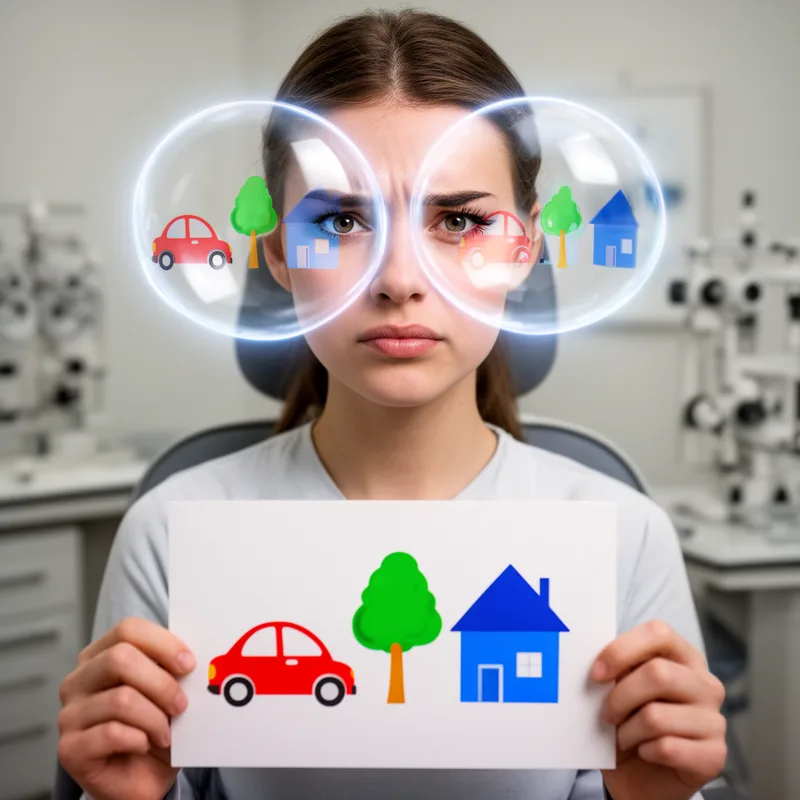
aniseikonia
- noun
- /ˌænɪseɪˈkoʊniə/
- Specialized
- Aniseikonia can make activities like reading and driving particularly challenging due to inconsistent image perception.
Examples
-
Special corrective lenses are often prescribed to help people suffering from aniseikonia.
-
The ophthalmologist diagnosed the patient with aniseikonia after noting discrepancies in her vision.
-
The doctor diagnosed her with aniseikonia after her vision tests.
-
He experiences aniseikonia, making it hard for him to focus.
-
Aniseikonia can cause significant difficulties in tasks that require both eyes to work together, such as driving or reading.
-
For individuals with aniseikonia, wearing specially designed glasses can greatly improve their visual experience.
-
After the examination, the optometrist confirmed that the patient was suffering from aniseikonia, leading to problems with depth perception.
Synonyms


 1
4.7
A problem with your sight that makes things look unclear
 1
4.3
A problem in the eyes that makes it hard to see
Surface Forms
Morphology
aniseikonia = aniso + eikon + ia
This is a technical Greek-derived medical term (aniso- 'unequal' + eikon 'image' + -ia) whose elements are not productive or recognizable to average learners, so the meaning cannot be reliably derived from its parts.
Etymology
Aniseikonia comes from Greek parts aniso- meaning 'unequal' and eikon meaning 'image' (like the English word 'image'). So, it literally means 'unequal images', which is why aniseikonia describes when each eye sees a different-sized image.