
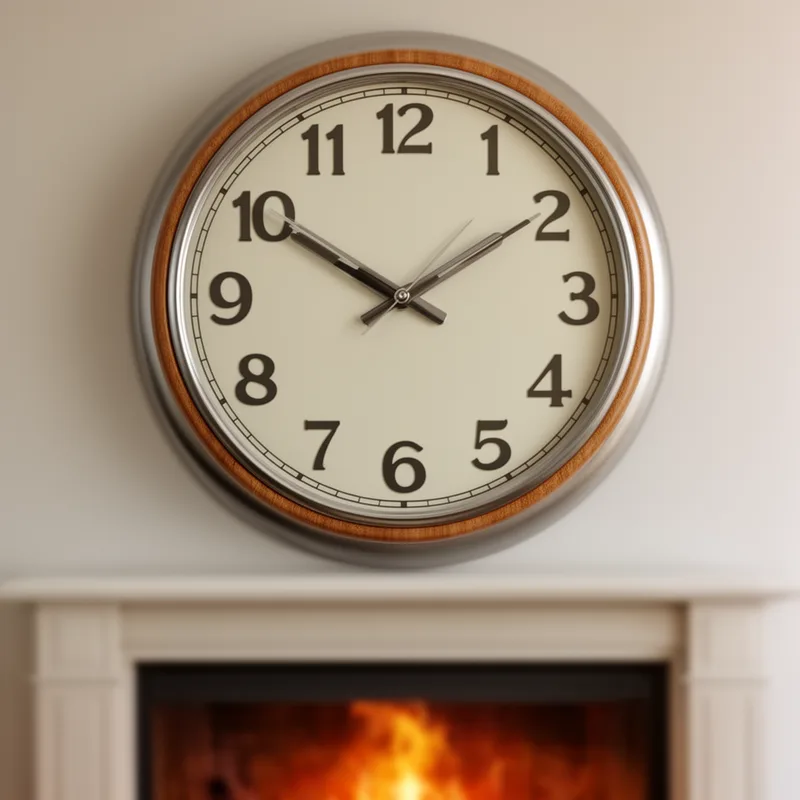
analog clock


 1
2.6
1
2.6
- noun
- /ˈænəˌlɔɡ klɑk/
- US
- In the center of the dashboard in this car you have an analogue clock, the mark of a true luxury automobile.
- looking at the analog clock
Loading YouTube…
Watch on YouTubeIn the center of the dashboard in this car you have an analogue clock, the mark of a true luxury automobile.
- In the center of the dashboard in this car you have an analogue clock, the mark of a true luxury automobile.
Examples
-
Early elementary grade classrooms or special education departments often have an analog clock face stamp.
Academic text (2013) -
It's a single analog clock that sits or goes with you wherever you are and just says tax time when the time is right.
-
In the greater scheme of things, I don't care if someone knows how to read an analog clock.
Blog text (32) -
Analog clocks seem to be going the way of the slide rule.
Blog text (32) -
But one thing that analog clocks do is provide practice at dividing a circle.
Blog text (32) -
The display of a standard analogue clock makes no distinction between 4 AM, 4 PM, and 4 PM next Thursday.
Blog text (31) -
Even though most of us grew up in a time when digital watches were the norm, learning how to read an analog clock face is a handy skill that would have been far easier to master.
Blog text (24) -
Address telling time objectives by printing or stamping an analog clock onto a card and writing digital times on clothespins (Grades 1-3 MD CCSS).
Academic text (2013) -
The dashboard features a sleek analog clock that adds elegance to the car's interior.
-
He taught the children how to tell time using an analog clock with moving hands.
Synonyms
 ∞
1.0
∞
1.0
A device that shows the time of day, usually on a dial or screen
How Analog
- US
1
2.6
 4
1.8
4
1.8
Surface Forms
Morphology
The meaning is directly compositional: 'analog' (continuous/non-digital) qualifies 'clock', so a learner who knows both words can infer it is a clock that displays time via continuous hands/motion rather than digits. This contrast with 'digital clock' is common cross-linguistically and follows transparent English compounding patterns, making it accessible to B1 learners.
Etymology
Analog clock comes from the idea that the clock shows time in a continuous, picture-like way: moving hands on a dial point to the numbers as time passes. So analog clock means a clock with moving hands, not one that shows 'digits'.