

amusia
- noun
- /əˈmjuːziə/
- Specialized
- Dyslexia, autism, developmental prosopagnosia, amusia, all of these things and others.
Examples
-
Amusia is a congenital disorder; people with the condition have a hard time detecting the direction of pitch changes and can't tell some notes apart.
Blog text (1) -
People with amusia often find it difficult to enjoy music, as they cannot recognize melodies or rhythms.
-
OK, so all of that suggests that this Amusia is really more about pitch than speech.
-
The literature on "amusia," loss of musical function due to destruction of brain tissue, gives further evidence of modularity.
Academic text (2000) -
The research literature on amusia reveals that destruction of brain tissue may eliminate a particular musical function (e.g., the ability to track rhythms).
Academic text (2000) -
Diagnosed with amusia, he struggled to match pitches when singing along to his favorite songs.
-
A teacher noticed that her student had amusia because he couldn't keep time with the music during class activities.
Synonyms

 2
9.4
2
9.4

Cannot hear small differences in music or people's speech
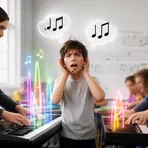
Unable to hear differences between musical notes

Not able to sing, play, or understand music well
Antonyms

Surface Forms
Morphology
Etymology
Amusia comes from the Greek parts a- meaning 'not' and mousa meaning 'muse' or 'music', the same root as the English word music. So amusia literally means 'without music', which explains the condition where a person cannot hear or make musical notes.