
aljamiado
- noun
- Specialized
- Early students of Aljamiado suggested that the motive was concealment, an intent to hide the content of Islamic works from the Inquisition.
Examples
-
Aljamiado does, however, find a parallel in Ladino, the form of Judeo-Spanish employed for translating the Pentateuch and other sacred texts; in fact, since Arabic and Hebrew are so closely related, many of the syntactic structures of Aljamiado and Ladino are the same.
Academic text (1995) -
Researchers have discovered new examples of aljamiado in historical manuscripts that showcase its unique linguistic features.
-
Many of the Mancebo's coinages occur nowhere else in Aljamiado literature.
Academic text (1995) -
But these particular Arabisms found in Aljamiado have not survived because the Spanish Islamic world to which they belonged has perished.
Academic text (1995) -
The Poema de Yucuf, perhaps the best-known Aljamiado work by virtue of being composed in cuaderna via, may belong to this period.
Academic text (1995) -
I now turn, therefore, to an original Aljamiado work—not a translation—in which the Moriscos' refashioning of Spanish reaches its utmost expression.
Academic text (1995) -
Hegyi ("Tradition" 385-86) has provided us with a beautiful illustration in the Aljamiado noun dormitanca, obviously a derivative of dormir but one not developed by the standard language.
Academic text (1995) -
Aljamiado is also full of semantic calques: expressions all of whose words are Romance, but which constitute such literal translations of an Arabic term that they are unintelligible without knowledge of the original language.
Academic text (1995) -
Many scholars study aljamiado texts to understand the cultural exchanges between the Arabic and Spanish languages.
-
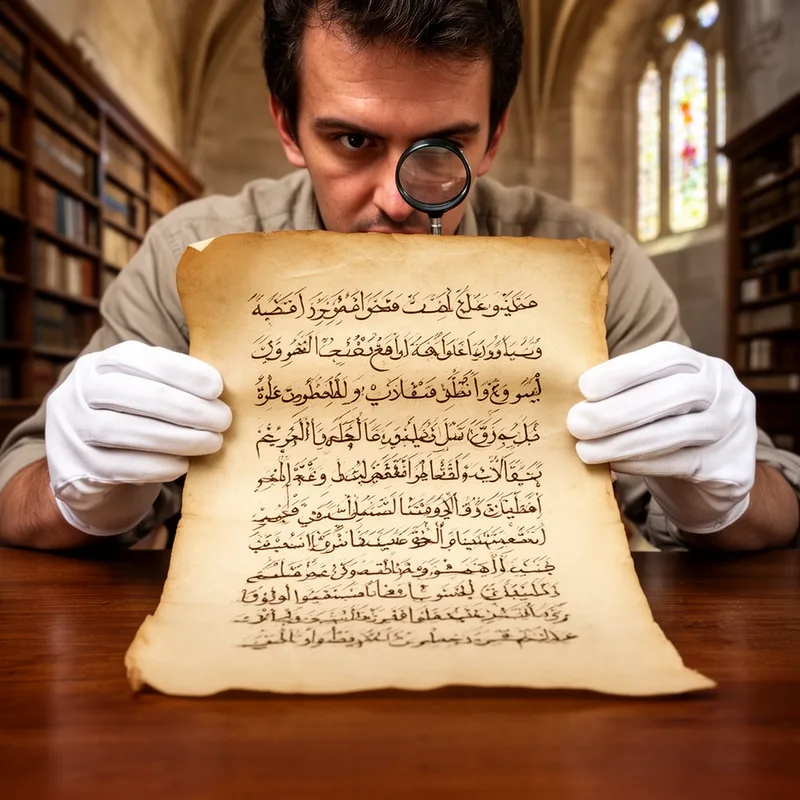
The aljamiado practice allows speakers of Romance languages to use Arabic script for their written communication.
Surface Forms
Etymology
The noun aljamiado names a text or the practice of writing Spanish or other Romance languages with Arabic letters. It comes from Arabic al- 'the' and ajami 'foreign', so it literally means the 'foreign' writing and explains why it refers to Romance texts written in Arabic script.

