

aleatoric music
- noun
- /ˌeɪliəˈtɔrɪk ˈmjuzɪk/
- Specialized
- Many modern composers experiment with aleatoric music, allowing performers to make creative choices during the performance.
Examples
-
They now have fewer reservations about performing aleatoric music or compositions that their audience might find strange.
Academic text (1996) -
All of these undeterminable elements will make a lasting and resonating symphony inspired by aleatoric music, where chance elements are accommodated within a pre-set structure of possibilities.
Blog text (15) -
The concert featured a piece of aleatoric music that changed every night based on the musicians' decisions.
-
During the workshop, participants were encouraged to explore aleatoric music by incorporating randomness in their compositions.
Synonyms
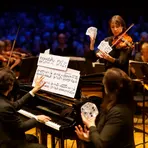
Music where some parts are left to chance or the performer's choice during a performance

Music in which some sounds happen by accident or by a player's choice
How Random


Surface Forms
Morphology
The adjective 'aleatoric' (involving unpredictability or chance) combines directly with 'music' in a standard adjective+noun pattern, so the meaning 'music involving chance or performer discretion' is compositionally derivable from the parts. This is a transparent, regular semantic modification (and the term has cognates in several languages), so a learner who knows both constituent words would understand the phrase.
Etymology
The term aleatoric music comes from a word for 'dice': aleatoric suggests rolling dice, and music is the sound that follows when players make choices. So, it means music where some elements are left to 'chance' or to the performer's choice, making each performance different.