
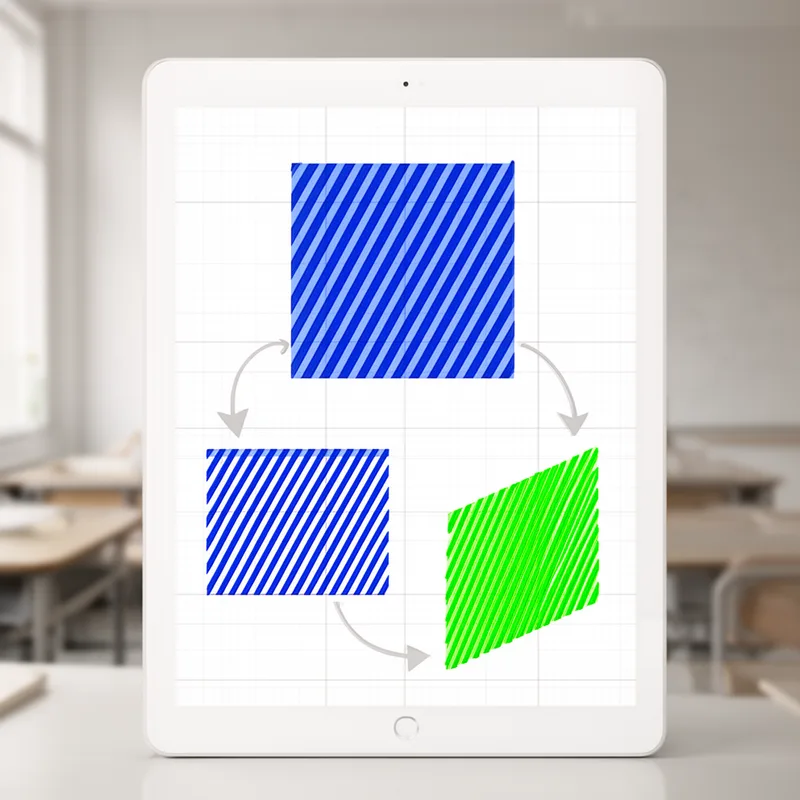
affine geometry
- noun
- /əˈfaɪn ˈdʒiːəˌmɛtri/
- Specialized
- In affine geometry, parallel lines remain parallel after any affine transformation.
Examples
-
Unlike Euclidean geometry, affine geometry does not preserve angles or distances.
-
Many algorithms in computer graphics are founded on the principles of affine geometry.
-
In affine geometry, parallel lines never meet.
-
The study of affine geometry is essential for understanding transformations.
-
In affine geometry, the properties of shapes are preserved through transformations like scaling and translation.
-
Many concepts in computer graphics are based on affine geometry, which studies how objects change under various transformations.
-
Students learn about affine geometry to understand how parallel lines remain unchanged despite transformations.
Surface Forms
Morphology
Although 'geometry' is a common word, 'affine' is a specialist mathematical adjective whose meaning (relating to affine transformations like translations, scalings and shears) is technical and not inferable from general English knowledge. A B1 learner who knows the surface forms of both words but lacks domain knowledge of affine transformations would not be able to derive the specific meaning, so the compound is not transparent.
Etymology
Affine geometry comes from the idea behind affine, a word that suggests 'related', and geometry, the study of shapes; picture a drawing you can slide, stretch, or slant so lines stay parallel while angles change. That's why affine geometry means the study of what stays the same after such moves.

