

aestheticization


 1
8.6
1
8.6
- noun
- /æˌsθɛtɪsaɪˈzeɪʃən/
- Formal
- The aestheticization of the urban landscape often leads to a focus on appearance rather than the needs of the community.
- aestheticization of war
- aestheticization of politics
Examples
-
That's the further aestheticization of my office store.
-
The condition is that of "diffuse aestheticization" we can find on a daily basis in the media.
Academic text (1995) -
But this aestheticization also had a source in community culture that supplied the key to No Movie performance: posing.
Academic text (1999) -
The aestheticization of the homes within the photographs further removes the subject from Mthethwa's work.
Academic text (2010) -
The aestheticization of the obento is by far its most intriguing aspect for a cultural anthropologist.
Academic text (1991) -
Through aestheticization, Vertov grants them a humanistic autonomy from production, from their place in nature as productive machines.
Academic text (1999) -
I argue that the successful aestheticization of a neighborhood requires the materialization of landscape aesthetics through particular iterations of property.
Academic text (2011) -
The first half of the twentieth century witnessed, in the Western world, a growing appreciation for and attendant aestheticization of objects from sub-Saharan Africa, formerly perceived as either ethnographic curiosities or examples of material culture.
Academic text (2003) -
The aestheticization of everyday objects can make them more appealing, even if their functionality is compromised.
-
Many artists seek aestheticization in their work, prioritizing beauty over practicality.
Synonyms
 39
1.0
39
1.0
Making something look more attractive by adding things like lights or ornaments
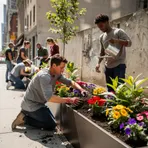 7
4.2
7
4.2
Making a place or thing look nicer
 6
4.9
6
4.9
Details added to make something look more beautiful
 1
7.2
1
7.2
Making something seem more attractive or exciting than it really is
 1
8.1
1
8.1
Making something look nicer or more special than it really is

To make something look more attractive using paint, plants or lights
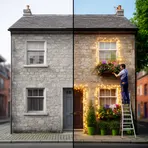
Making something look nicer without changing how it really is

Small changes that make a room or thing look nicer

Making something look more attractive than it really is
Antonyms

How Aesthetic

Surface Forms
Morphology
aestheticization = aestheticize (semi-transparent) = aesthetic + ize + ation
The noun is a regular nominalization of 'aestheticize', so the derivation is straightforward.
Etymology
Aestheticization comes from aesthetic meaning 'beauty' or 'artistic feeling' and the ending -ization meaning 'the act of making'. Think of it as 'turning something into beauty', which explains why it means focusing on how things look or treating them as art, sometimes ignoring practical or moral aspects.