
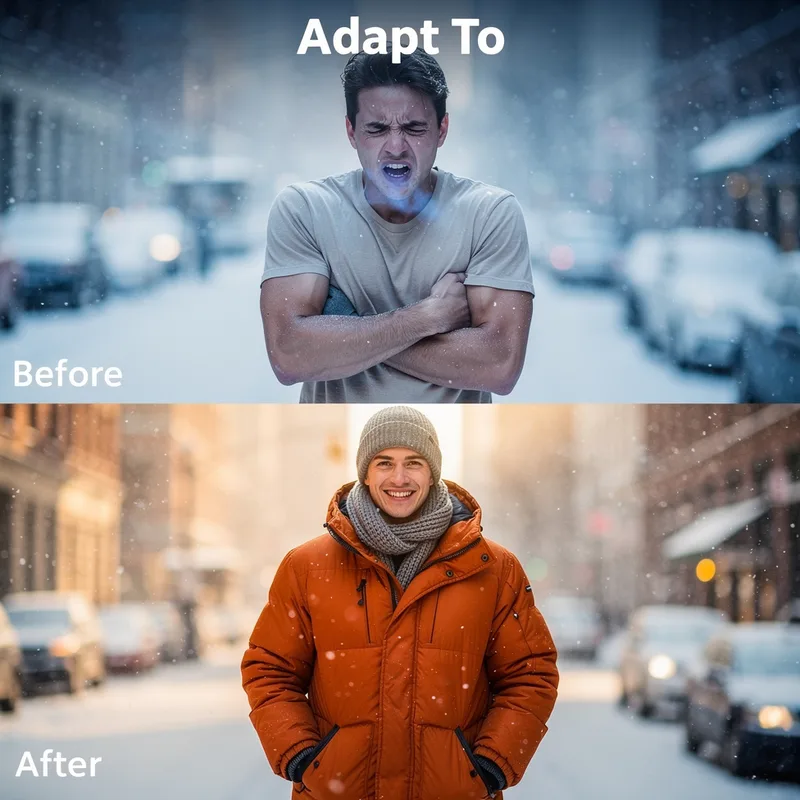
to adapt to
 99
2.9
99
2.9

- phrasal verb
- /əˈdæpt tu/
 :
adaptarse a
:
adaptarse a
- Then I was worried I was gonna have to adapt to life as a street person in Madrid.
- adapt to change
- adapt to new situations
- adapt to new situations
I think I have adapted to just not having much time.
- I think I have adapted to just not having much time.
- He knows who he is and has adapted to his dyslexia.
- And, you know, I thought he adapted to a new position, new role.
- Now fashion houses must adapt to that change market.
- And to me, what you had to adapt to here was simply the weather.
- So it's going to be a challenge to adapt to the life in London.
- Are the country's institutions beginning to adapt to what is happening on the ground?
- Bed Bath and Beyond never adapted to really getting into e-commerce.
- But basically we just adapt to what happens to us.
- And it's about how you adapt to those changes.
- So you can adapt to eating a certain type of a food.
- And it's any friendship really where both people don't adapt to each other and evolve.
- It's changed to adapt to the needs of society.
Examples
-
So it's going to be a challenge to adapt to the life in London.
-
It's been quite difficult to adapt to working from home.
-
I think I have adapted to just not having much time.
-
Your body and mind have adapted to that.
-
Those who survived have adapted to a new world.
-
The New York Stock Exchange has been slow to adapt to these technologies.
-
So it's, I think it's constantly adapting to this changing world.
-
Are the country's institutions beginning to adapt to what is happening on the ground?
-
Nonetheless, the IDF made efforts to adapt to the new situation in several areas.
Academic text (1991) -
It was challenging at first, but I finally adapted to living in a big city.
Synonyms
 514
2.4
514
2.4
Begin to feel comfortable with something that once felt strange
 321
3.0
321
3.0
To get used to new conditions like a new place or routine
 139
3.6
139
3.6
To make someone used to something so it feels normal
 132
3.3
132
3.3
To start to feel comfortable and at home in a new place or job
 41
3.3
41
3.3
Become comfortable in a new place, job, or routine
 25
5.2
25
5.2
To get used to a new climate, place, or situation
 6
6.5
6
6.5
Become used to a new situation so you feel comfortable with it
 4
6.1
4
6.1
To get used to a new climate or place
Antonyms

How Adapted
41
3.3
 99
2.9
25
5.2
514
2.4
321
3.0
99
2.9
25
5.2
514
2.4
321
3.0
Surface Forms
Morphology
adapt + to
The meaning 'to gradually adjust or become accustomed to' is directly derivable from 'adapt' (to adjust) combined with the preposition 'to' which marks the target or situation being adjusted to. This verb + preposition composition is a regular, cross-linguistically common pattern and would be understandable to a B1 learner who knows the constituent words.
Etymology
Adapt to comes from the idea of adapt meaning 'fit' and to showing where you fit. Imagine a chameleon slowly changing colour to match a leaf or putting on a coat when it gets cold; that picture explains why adapt to means 'to gradually adjust' or 'get used to' a new situation.