
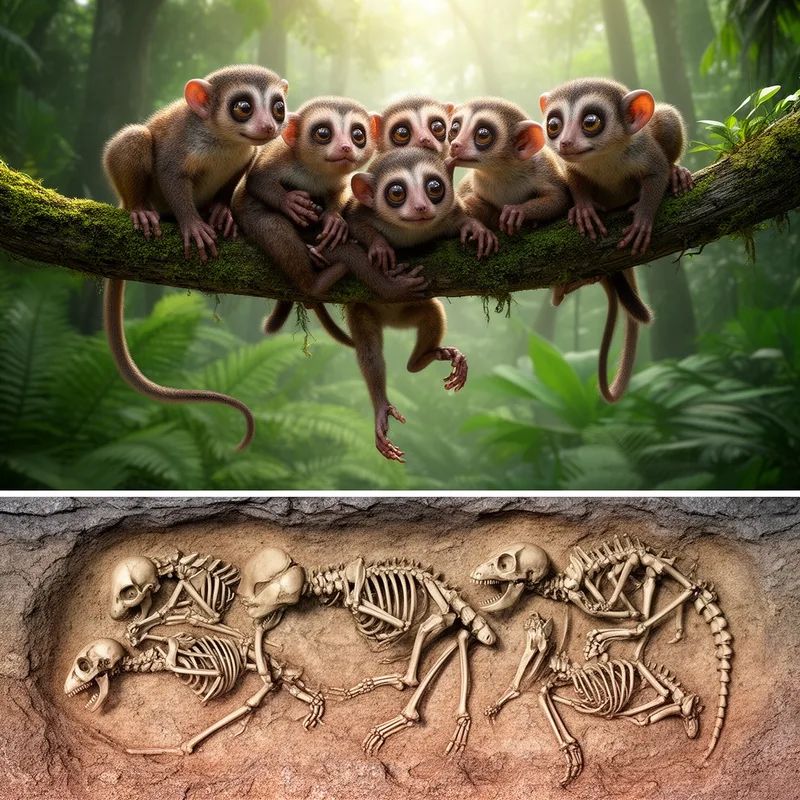
adapid group
- noun
- /ˈæd.ə.pɪd ɡruːp/
- Specialized
- Fossils from the adapid group offer clues about primate evolution.
Examples
-
The adapid group was abundant in Europe and North America during the Eocene epoch.
-
Many paleontologists believe that the adapid group is closely related to modern lemurs.
-
The adapid group of primates lived during the Eocene epoch.
-
Scientists believe the adapid group evolved into modern lemurs.
-
Fossils from the adapid group provide important insights into the evolution of early primates.
-
Researchers found that the adapid group thrived in tropical forests millions of years ago.
-
Paleontologists have identified several species within the adapid group that existed during the Eocene period.
Synonyms

A small extinct primate that lived 30 to 50 million years ago and is related to lemurs
Surface Forms
Morphology
The phrase is a straightforward noun + noun composition: knowing 'adapid' (a type of extinct primate) plus 'group' (a collection) lets a learner infer 'a group of adapids'. This is a directly compositional, cross-linguistically common pattern, so the meaning is transparent to a learner who already knows the constituents.
Etymology
Adapid group comes from the fossil name Adapis, after the first small primate bones found near Paris in the 1800s. Because those bones were from small, mostly daytime animals that look like the ancestors of lemurs, adapid group now means a group of 'early primates' thought to be 'related to lemurs'.

