
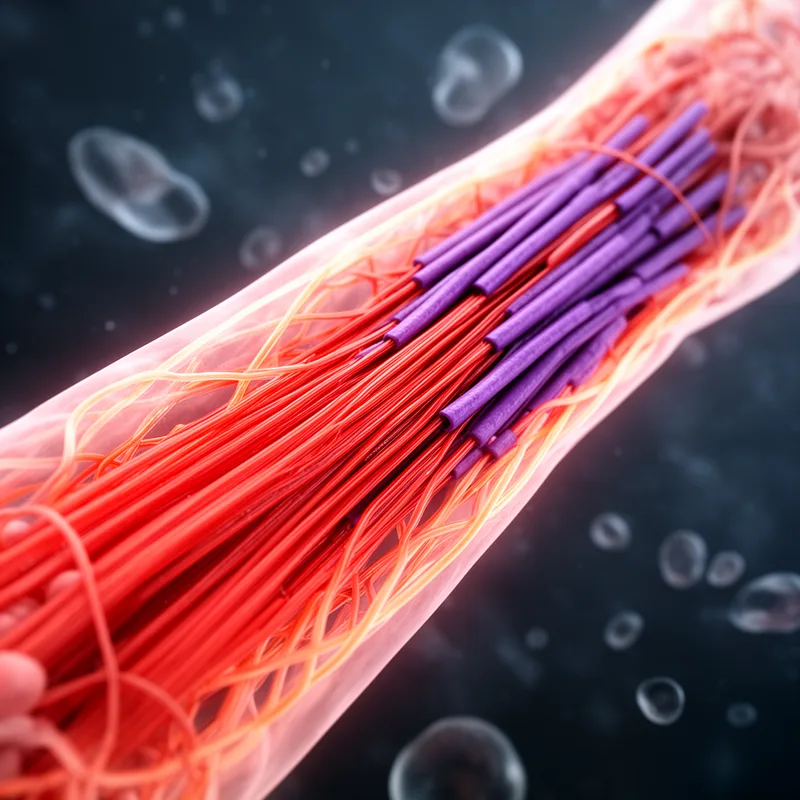
actin
 2
7.3
2
7.3

- noun
- /ˈæktɪn/
- Specialized
- So here we have a dendritic cell that is migrating through those channels and in red we can see the DNA and in green the actin cytoskeleton.
- actin filaments
- muscle actin
- actin polymerization
Loading YouTube…
Watch on YouTubeEstrogen is responsible for how strong myosin attaches to actin.
- Estrogen is responsible for how strong myosin attaches to actin.
- The bond between the cross bridge, the myosin actin gets stronger, the calcium affinity is the phrase that we use there increases.
Examples
-
When it's hyperactivated, it drives actin depolymerization.
-
What kind of molecules are actin and myosin?
-
Here's a graph of motor activity as a function of actin concentration.
-
Stress fibers are mostly formed by actin and myosin.
Academic text (2017) -
Most expressed sarcomeric actin, a specific marker for cardiac myocytes.
Academic text (2003) -
F-actin appeared to exhibit a scattered distribution, and the normal junctions between cells were lost.
Academic text (2018) -
RhoA GTPase is a major factor responsible for actin fiber stabilization.
Academic text (2017) -
In time, the cascade of internal signaling events results in the polymerization of actin filaments at the front of the cell.
Academic text (2012) -
We also examined whether actin is contained in the MD- and PD-rings and the microbody in C. merolae.
Academic text (1996) -
The protein actin plays a crucial role in muscle contractions by interacting with myosin filaments.
How Polymerized
- Specialized

- Specialized
2
7.3
Surface Forms
Etymology
Actin comes from the Greek aktis, which means 'ray', because actin proteins form thin, ray-like threads inside cells. So, think of a small 'ray' or filament when you remember that actin helps give the cell its shape and lets it move.