
absolute space


 1
9.6
1
9.6
- noun
- /ˈæb.sə.luːt speɪs/
- Specialized
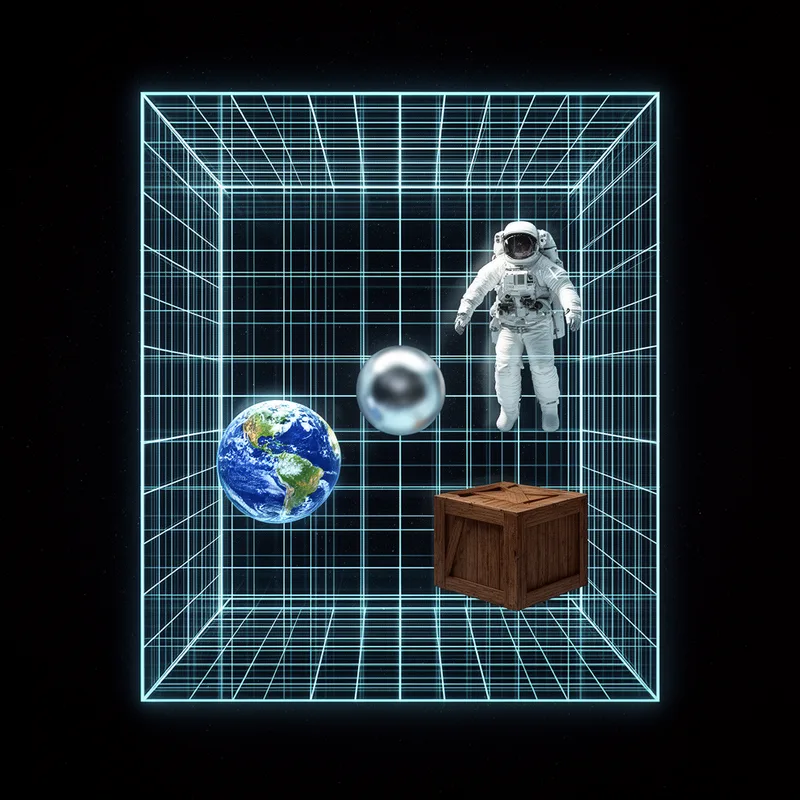
- As John Polkinghorne reminds us, "Newtonian physics had pictured physical processes as involving the collisions of individual atoms moving in the container of absolute space and absolute time."
- absolute space and time
Examples
-
An absolute space entails that something besides extension must be posited in matter.
Academic text (2016) -
Simply put, Newton's laws define motion as a concept of acceleration occurring within the coordinates of absolute space and time (themselves unaffected by the motion of bodies).
Academic text (2009) -
So I have a general idea of how people describe absolute space and how they compare it to relative space.
-
Absolute space and time constituted a universal reference frame.
Academic text (2009) -
The logical view in terms of 'what things-in-themselves do' assumes 'absolute space.'
Blog text (4) -
Place is now seen not as a subdivision of absolute space or as a unit of space that can be objectively determined, but as a part of our perception of the physical world.
Academic text (2018) -
In the place of absolute space and time, Einstein postulates a codependent spatiotemporal universe.
Academic text (2009) -
Thus absolute space, absolute time, geometry itself, are not conditions which impose themselves on mechanics; all these things are no more antecedent to mechanics than the French language is logically antecedent to the verities.
Blog text (13) -
It is because the Newtonian conceptions of absolute space and time give rise to such choices that Leibniz rejects them, citing the PSR as his authority.
Academic text (1998) -
All matter and energy move relative to each other but not to absolute space.
Surface Forms
Morphology
The noun phrase is compositionally built from 'absolute' (meaning independent/not relative) modifying 'space' (physical area), so its core meaning — space that exists independently or is not relative — is directly derivable from the constituents. A B1 learner who knows both words can infer the basic sense, with only specialized philosophical nuance requiring extra explanation.
Etymology
Absolute space comes from the image of space as a fixed, empty stage—like a theatre that stays in place even when no actors are there. People used absolute to mean 'on its own' and space to mean the empty stage, so 'absolute space' means space that exists by itself, not only because of the things in it.