
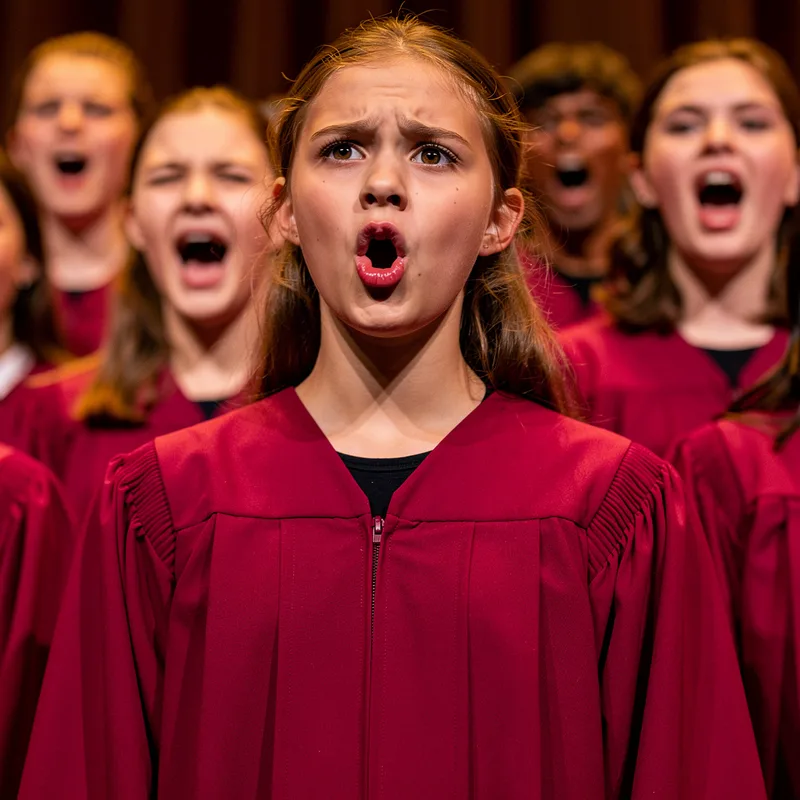
to mouth the words
 6
6.9
6
6.9

- phrasal verb
- Now you're mouthing the words.
Examples
-
And I saw him mouth the words, "Help us."
-
Just make sure that you mouth the words exactly like we recorded them.
-
When they were talking , he mouthed the words, "Help us."
-
We can't just mouth the words anymore.
-
"In your room," she said, mouthing the words as if they were part of a foreign language.
Fiction book (1993) -
We see the woman mouthing the Cantonese words for "come here."
Fiction book (1999) -
Niklas stared at him and mouthed the words, "Yes, I see."
Fiction book (2002) -
Wonder Woman turned to me, smiled, and mouthed the words, "You don't need a rope."
Fiction book (1997) -
Delicately, she changed Shy's diaper, mouthing the words along with the singer.
Fiction book (1993) -
He stood at the back, mouthing the words to the song silently, lost in the music.
Synonyms
 36
8.1
36
8.1
To move the lips to form words without making sound
 11
4.6
11
4.6
To move the lips to match recorded speech or music
 1
6.6
1
6.6
To move your lips to match recorded singing or speech so it looks like you sing
How Loud

Surface Forms
Morphology
The verb 'mouth' already encodes the action of forming words with the lips without sound, and combining it with the literal direct object 'the words' yields the described meaning with no idiomatic shift. This is a straightforward compositional pattern found in many languages, so a B1 learner who knows the constituents can readily infer the meaning.
Etymology
Mouth the words comes from the clear image of someone moving their mouth to form the words but making no noise. That's why it means 'to move your lips to form words without making sound', often to pretend to speak or sing.