
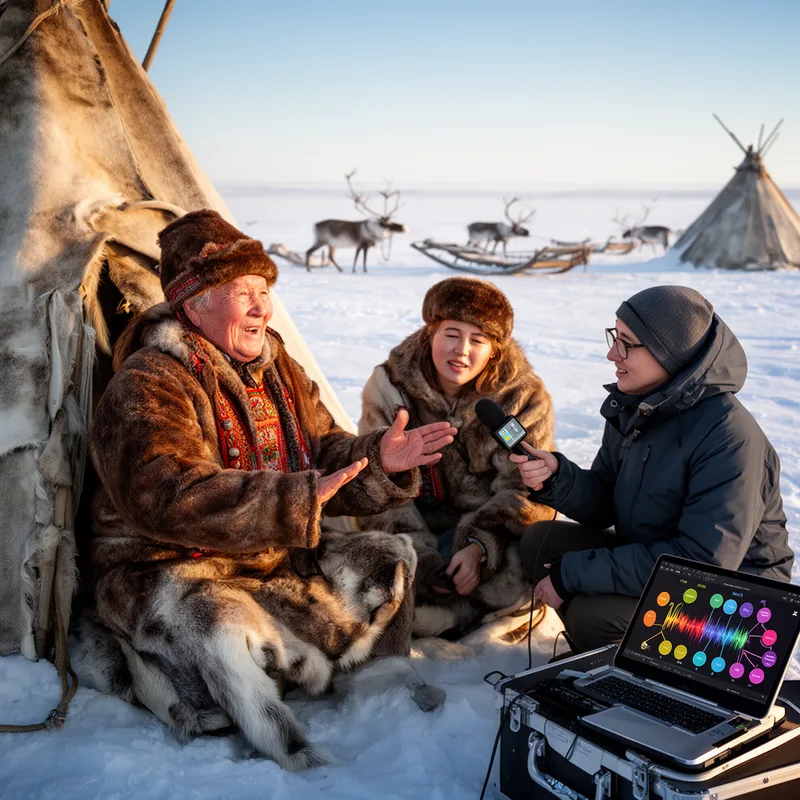
Yurak-Samoyed language
- noun
- Archaic
- Few speakers of the Yurak-Samoyed language remain today as most have shifted to Russian.
Examples
-
Linguists study the Yurak-Samoyed language to understand the Uralic language family's history.
-
The Yurak-Samoyed language is closely related to other Samoyedic languages of Siberia.
-
The Yurak-Samoyed language is nearly extinct today.
-
Many linguists study the Yurak-Samoyed languages of Siberia.
-
The few remaining speakers of the Yurak-Samoyed language use it mostly in traditional settings.
-
Researchers are documenting the Yurak-Samoyed language to preserve its unique vocabulary and grammar.
-
In some communities, the Yurak-Samoyed language is taught to children to keep their cultural heritage alive.
Synonyms


 1
9.9
A language spoken by the Nenets people in northern Siberia
 1
9.9
A language spoken by the Nenets people in northern Siberia
A language that the Nenets people once spoke in northern Siberia
A language spoken by the Nentsy people in northern Siberia
A language spoken by the Nenets people in northern Siberia
A language spoken by the Nenets people in northern Siberia
A language spoken by the Nenets people in northern Siberia
Surface Forms
Morphology
This is a straightforward composition of a proper name/ethnonym 'Yurak-Samoyed' and the noun 'language', so the meaning ('the language spoken by the Yurak-Samoyed/Nenets') is directly derivable from the constituents. Demonym/adjective + language constructions are cross-linguistically common and follow a regular compositional pattern, making this immediately comprehensible to a learner who knows both parts.
Etymology
Yurak-Samoyed language comes from old Russian names for the people who spoke it: Yurak was what Russians called the Nenets, and Samoyed was an older word for some northern groups. That's why the name refers to the language of those Siberian people, now usually called 'Nenets'.