
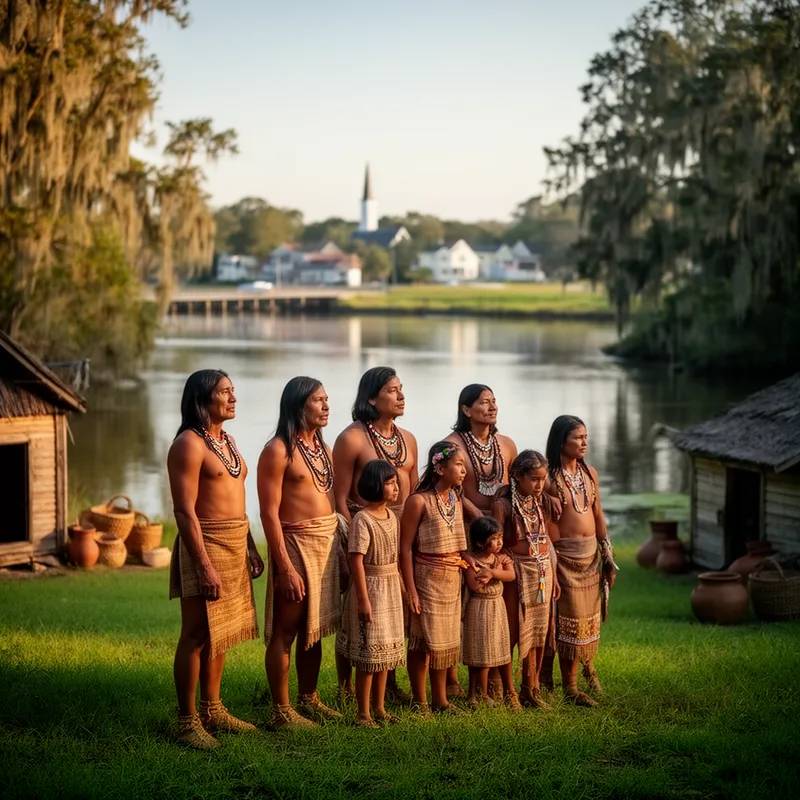
Yamacraw


 1
9.9
- proper noun
- Yamacraw eventually became one such town centered on the leadership of Tomochichi.
- Yamacraw leader
- Yamacraw Bluff
- group of Yamacraws
Examples
-
Causton provided the Yamacraw leader with various provisions in exchange for his diplomatic skills.
Academic text (2008) -
His first references to Tomochichi identify him as the chief of the Yamacraw Tribe and mention his interest in learning more about the Christian religion.
Academic text (2008) -
Governor Robert Johnson of South Carolina had warned the Yamacraw leader weeks before that more British immigrants were coming, so Tomochichi had time to prepare.
Academic text (2008) -
Most importantly, the couple sought English title to lands on the Savannah River that the Yamacraw Indians had gifted to Mary in 1737.
Academic text (2015) -
When the local Yamacraw Indian tribe approached the new English arrivals to negotiate, he became Georgia's Indian ambassador by default.
Academic text (2011) -
Set in the year 1733, Poore's story explores the circumstances of James Oglethorpe's arrival at Yamacraw Bluff and his encounter with Tomochichi.
Academic text (2015) -
When Tomochichi met Oglethorpe, he should have represented just his small group of Yamacraws, but instead he acted as a broker for the larger Creek polity.
Academic text (2008) -
But I was born on a farm in Yamacraw, North Carolina.
-
On the first day, a delegation of Yamacraw Indians dropped by and declared their peaceable intentions.
-
Only seven days before Oglethorpe arrived at Yamacraw Bluff, Gilbert Heathcote died.
Synonyms
 4
9.9
A Native American people from eastern Virginia or their language
 1
9.9
A Native American people from the southeastern United States, also called the Creek Nation
 1
9.9
A Native American people from the Great Lakes area
Surface Forms
Etymology
Yamacraw is the name of a Native American people from the southeastern United States and of places named after them. It comes from a Native American name, so when you see Yamacraw in history or on a map it means that group or a place named for them, much like Cherokee names both a people and many places.