
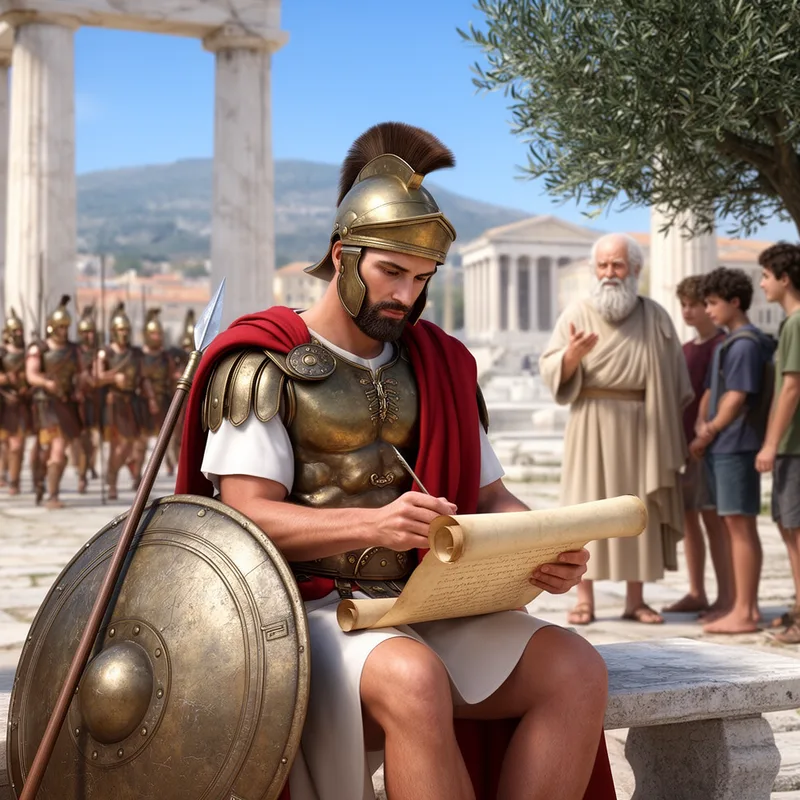
Xenophon


 1
9.5
- proper noun
- /ˈzɛnəfən/
- Sophocles, Aristotle, Xenophon, Cicero, and, in the Christian case, Augustine all lauded it.
- Xenophon and Plato
- Xenophon's Socrates
- Xenophon's Hiero
Loading YouTube…
Watch on YouTubeIf you want to understand Socrates, it's good to read Xenophon.
- If you want to understand Socrates, it's good to read Xenophon.
- And then he refers to Xenophon's banquet or symposium.
- And so Epictetus students wants to do for Epictetus what Xenophon did for Socrates.
- If you've ever suffered through Xenophon's analysis, it's full of parasangs.
- The most kind of homely dialogue that we have is in Xenophon.
Examples
-
First, Xenophon's and Plato's Socrates clearly recognized the difference between human and nonhuman things.
Academic text (1995) -
Xenophon's Cyrus is a prime example of such a type.
Academic text (1994) -
We march by day, and read Xenophon by night.
-
Now, in much the same way as the ancient tale of Xenophon, they had to find their way back home again.
-
Remember, Xenophon ends his tale of the end of the Peloponnesian War.
-
And then he refers to Xenophon's banquet or symposium.
-
Strauss went on to write in his 1970 study Xenophon's Socratic Discourse: "Our age boasts of being more open to everything human than any earlier age; it is surely blind to the greatness of Xenophon."
Academic text (2003) -
Xenophon wrote extensively about the events of his time, providing valuable insights into ancient Greek society.
-
In his works, Xenophon documented the life and teachings of Socrates, influencing future generations of philosophers.
-
Xenophon, a soldier and historian, played a crucial role in chronicling the history of the Peloponnesian War.
Surface Forms
Etymology
Xenophon comes from the Greek parts xeno- 'stranger' and -phon 'voice', so the name can be remembered as a 'foreign voice'. A helpful way to recall him is to think of that 'foreign voice' because he wrote about foreign lands and people and led Greek soldiers far from home.