
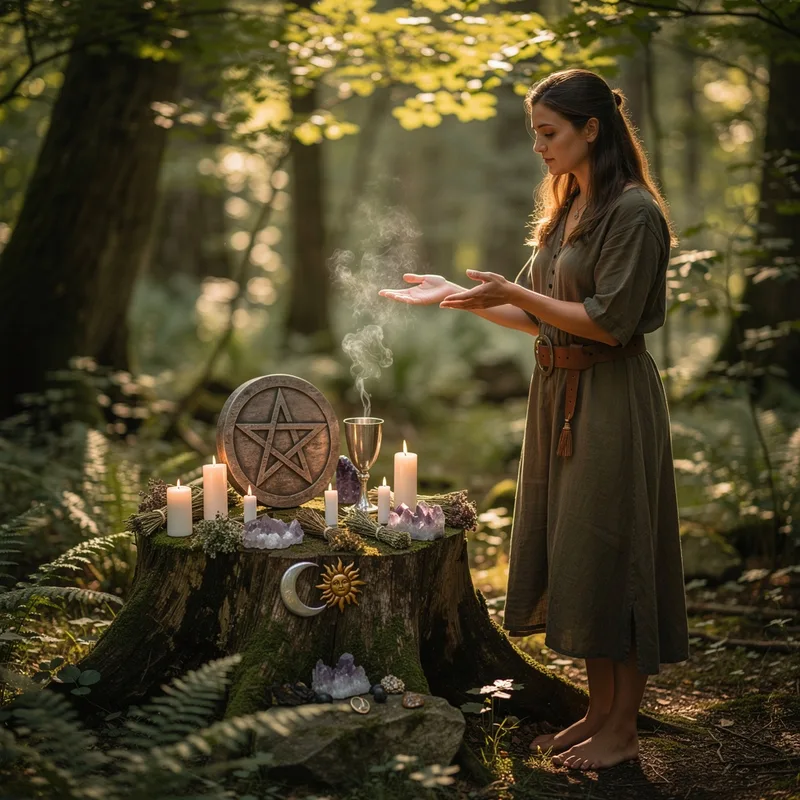
Wicca
 8
8.2

- noun
- /ˈwɪkə/
- During the festival, practitioners of Wicca celebrate the changing seasons with rituals and offerings.
- Wicca religion
- Wicca and witchcraft
- Wicca and paganism
Loading YouTube…
Watch on YouTubeWait, we do Wicca, why don't you join our group?
- Wait, we do Wicca, why don't you join our group?
- Friend of mine was in Wicca, the old religion of Wiccans.
Examples
-
Wicca is a life-affirming, positive system of spiritual beliefs and ritual practices.
Academic text (1997) -
I meant Gerald Gardner, who founded Wicca (though many claim they belong to traditions that owe nothing to him).
Blog text (8) -
We have strong spiritual practices; we both follow the ways of Wicca.
Fiction book (1997) -
Friend of mine was in Wicca, the old religion of Wiccans.
-
In New Mexico, a local Wiccan was invited to speak to a high school class on the differences between Wicca and Satanism.
Academic text (1997) -
Unlike many other authors, Lady Sabrina places her focus on the ritual aspects of Wicca, rather than the magical ones.
Fiction book (2002) -
As a form of organized religion, neopagan Goddess spirituality has its home in Wicca, modern witchcraft.
Academic text (1993) -
Focusing his remarks primarily on the accommodation of Wicca in correctional institutions, McCollum stated that discrimination against non-traditional religions was common.
Academic text (2008) -
Many people are drawn to Wicca because of its emphasis on nature and spirituality.
-
She joined a local group to learn more about the principles and practices of Wicca.
Surface Forms
Etymology
Wicca likely comes from an old English word wicca meaning 'male witch', and it is the same root as the familiar word witch. A helpful way to remember it is to think of Wicca as the modern name for a nature-based witchcraft religion, which is why the word now means that faith.