
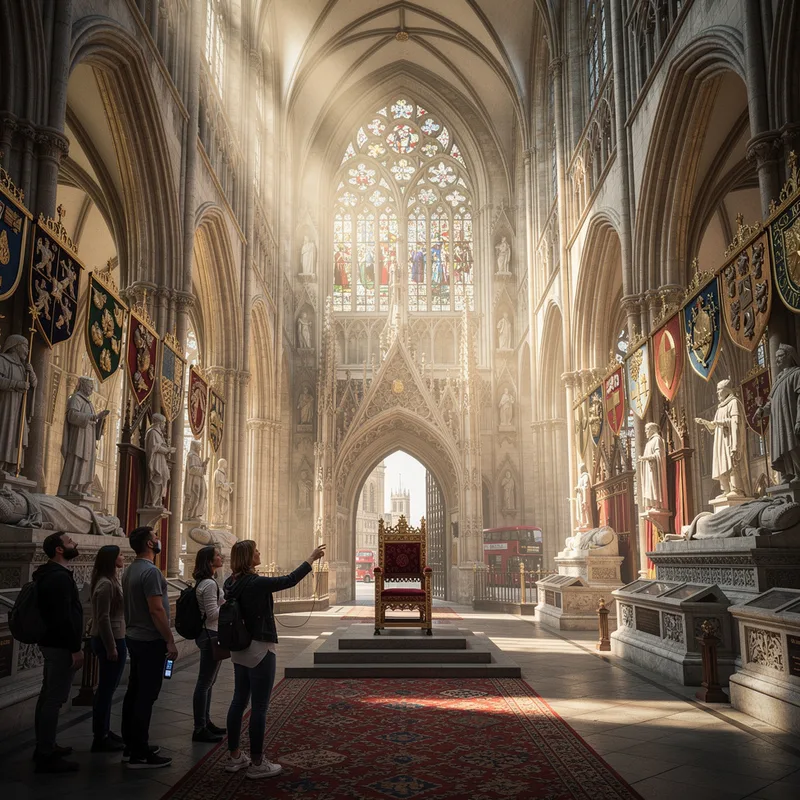
Westminster Abbey
 5
3.4
5
3.4

- proper noun
- A Te Deum composed by Prince Albert was central to the Westminster Abbey jubilee service.
- Westminster Abbey in London
- Westminster Abbey wedding
- Westminster Abbey jubilee service
Examples
-
She will be coronated at London's historic Westminster Abbey.
-
Hardy's remains were duly cremated and interred in Poets' Corner at Westminster Abbey, but not before his heart was removed from his body and transferred to Stinsford, where it was buried during a second funeral service.
Academic text (1990) -
I'd always imagined her lying in state in Westminster Abbey.
-
EDWARD VI WAS CROWNED KING OF ENGLAND IN WESTMINSTER ABBEY ON THE 20th OF FEBRUARY 1547.
-
Hardy's friend Sydney Cockerell, whom Hardy had named with Florence as joint trustee of his estate, had arranged for a ceremonious burial at Westminster Abbey, just as Maugham had written in "Cakes and Ale."
Academic text (1990) -
Queen Victoria did agree early in 1887 that it would be proper to mark the completion of her jubilee year, the fiftieth anniversary of her accession to the throne, with an appropriate ceremony of thanksgiving in Westminster Abbey, a building that she had not entered since her coronation forty-nine years earlier.
Academic text (1997) -
William was crowned king of England in London's Westminster Abbey on Christmas Day 1066.
-
For a thousand years, music and ceremony have celebrated the Christian Gospel in Westminster Abbey in London.
-
She will be coronated at London's historic Westminster Abbey.
Surface Forms
Morphology
A B1 learner who knows 'Westminster' as a place name and 'abbey' as a religious building can easily infer that 'Westminster Abbey' is the abbey located in Westminster; the core referential meaning is directly compositional. They may not know its specific fame for coronations and burials, but the basic sense (a specific religious building in Westminster) is transparent from the constituents.
Etymology
Westminster Abbey comes from old words that describe the church's place: Westminster meant the church on the 'west' side because minster is a 'large church', and an abbey was the 'home of monks'. So the name told people it was the monastery church on the west side, which is why today it is the famous church for crowning kings and queens and for important burials.