
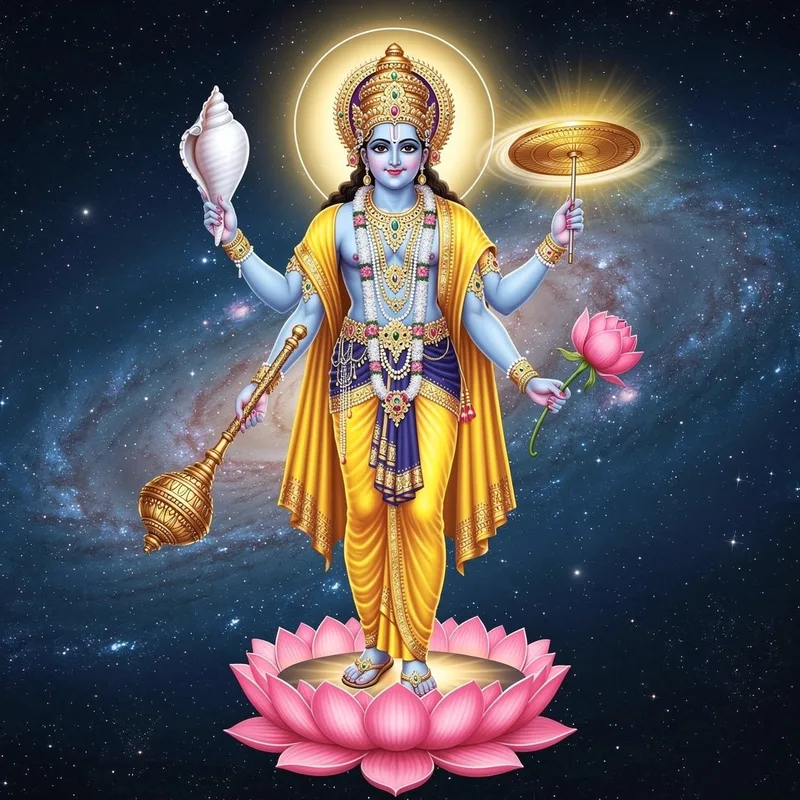
Vishnu
 8
7.2

- proper noun
- /ˈvɪʃnuː/
- In the Hindu religion, Vishnu and Siva represent, respectively, the sustenance and dissolution aspects of existence.
- incarnation of Vishnu
- Hindu god Vishnu
- great god Vishnu
Loading YouTube…
Watch on YouTubeWe're not asking for stuff, you know, We don't pray to Vishnu or to Krishna for what we want.
- We're not asking for stuff, you know, We don't pray to Vishnu or to Krishna for what we want.
Examples
-
According to the most widespread classification, there have been 10 of Vishnu's avatars (incarnations) on Earth.
Blog text (32) -
According to the ancient epic Ramayana, Ram, the incarnation of the Hindu god Vishnu, was born in the kingdom of Ayodhya.
Academic text (2004) -
And the god Vishnu, too, into the bargain.
-
Vishnu, the supreme soul, the source of all things.
-
An avatar of Vishnu, the supreme deity.
-
The temple was meant to mark the site where Rama, the avatar of Vishnu, was born.
Blog text (23) -
The great god Vishnu is said to have descended to Earth as an avatar ten (or more) times.
Academic text (1995) -
Here, Rama, an incarnation of Vishnu, is said to have worshiped Siva before his campaign against the demon king Ravana.
Academic text (2001) -
Just as Krishna is considered an avatar ("a divine manifestation") of Vishnu, so Jesus can be considered a different and distinct avatar.
Academic text (2009) -
Hindus believe that Vishnu is the preserver of the universe, maintaining order and dharma.
Surface Forms
Etymology
Vishnu comes from the Sanskrit name Viṣṇu, which means 'to pervade' or 'to be everywhere'. A helpful way to remember him is to think of Vishnu as the god who is present everywhere, which fits his role as the preserver and protector of the universe.