
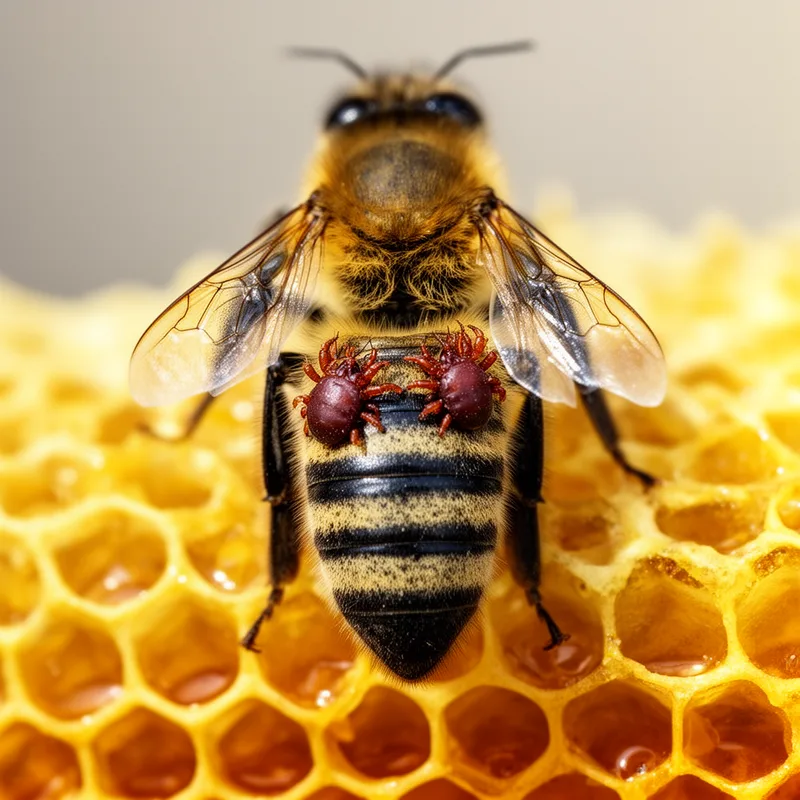
Varroa


 1
9.9
- proper noun
- /vəˈroʊə/
- Specialized
- "Beekeepers are happy that we're finding genetic resistance to Varroa, but most are cautious—and they need to be when it comes to controlling Varroa.
- Varroa mite
- resistance to Varroa
- Varroa mites on bees
Examples
-
He is trying to isolate which mechanism provides protection from Varroa mites.
Academic text (2004) -
For instance, if an SMR queen is mated to a male bee, or drone, without the SMR trait, the colony will still benefit from an intermediate level of around 50 percent resistance to Varroa.
Academic text (2004) -
The two traits together may enhance resistance to Varroa mites.
Academic text (2004) -
This species, Varroa destructor, is shown on a honeybee host.
Academic text (2011) -
The bee-infesting Varroa mite causes considerable economic losses for beekeepers and agriculture.
Academic text (2000) -
"Beekeepers are happy that we're finding genetic resistance to Varroa, but most are cautious—and they need to be when it comes to controlling Varroa.
Academic text (2004) -
About one-sixteenth of an inch in size, Varroa jacobsoni mites have attacked in nearly every state, killing bees needed for making honey and for pollinating an estimated $8 to $10 billion worth of crops.
Academic text (1999) -
ARS entomologist Frank A. Eischen at the Honey Bee Research Unit in Weslaco, Texas, has been studying AHBs for their resistance to Varroa mites.
Academic text (2004) -
Cytologist Bill Wergin (left) and entomologist Jeff Pettis examine a highly magnified photo of a honey bee infested with Varroa.
Academic text (2000) -
The bee-infesting Varroa mite causes considerable economic losses for beekeepers and agriculture.
Surface Forms
Etymology
Varroa comes from a surname, Varro, that scientists used when they named this group of tiny parasitic mites; think of Varroa as the 'Varro' mite to remember it is a small parasite that infests and harms honey bees.