
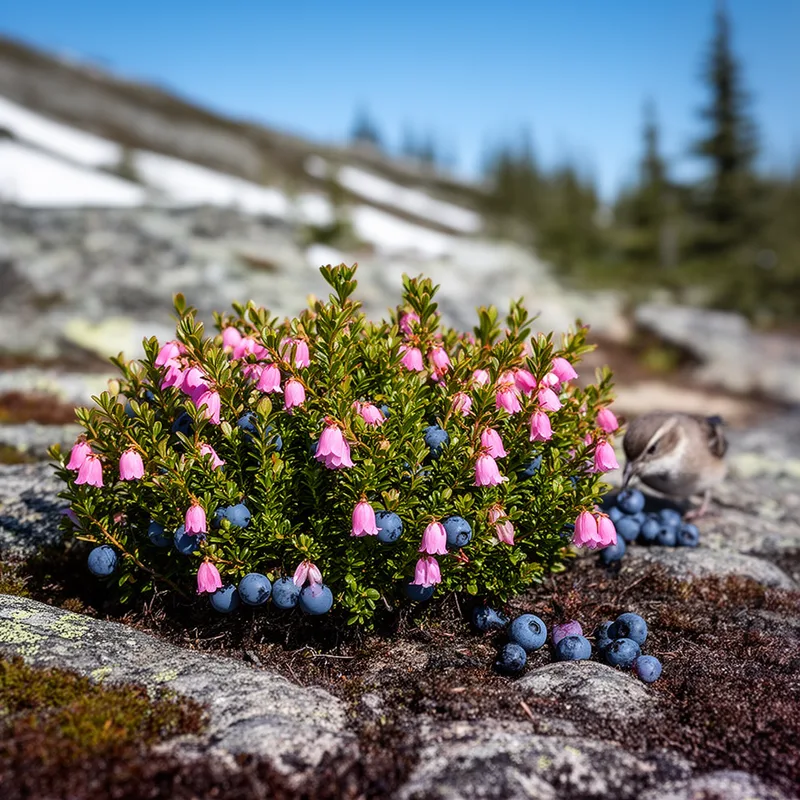
Vaccinium caespitosum
- noun
- Specialized
- The berries of the Vaccinium caespitosum are sweet and enjoyed by many birds and mammals.
Examples
-
During our hike, we spotted several Vaccinium caespitosum shrubs growing along the mountain trail.
-
The Vaccinium caespitosum thrives in rocky soils.
-
Botanists are interested in studying the pollination of Vaccinium caespitosum due to its unique alpine habitat.
-
Have you seen the Vaccinium caespitosum blooming this spring?
-
During our hike, we spotted several Vaccinium caespitosum shrubs growing along the mountain trail.
-
The berries of the Vaccinium caespitosum are sweet and enjoyed by many birds and mammals.
-
Have you seen the Vaccinium caespitosum blooming this spring?
Synonyms

A low bush that has small sweet blue berries

A low bush with pink flowers that has sweet blue berries
Surface Forms
Morphology
Vaccinium + caespitosum
This is a Latin scientific name where the first element signals a plant genus (Vaccinium) but the second element is a non-English Latin epithet ('caespitosum' is not a common English word and is absent from the learner dictionary). As a taxonomic label rather than a compositional English phrase, its specific descriptive meaning (low-growing, tufted shrub with pink flowers) is not derivable by a B1 learner from the constituents, so it is opaque.
Etymology
Vaccinium caespitosum is a plant name that joins Vaccinium (the blueberry group) with Latin caespitosum, which means 'growing in tight clumps'. Picture low, cushion-like shrubs with small blue berries packed closely together, and that image explains why the name describes a small, tufted blueberry shrub.

